Soybean quality preservation demands precision engineering, environmental control, and proactive monitoring throughout the storage cycle. This comprehensive soybean storage guide examines the critical factors that cause seed coat cracking and lipid oxidation, providing actionable strategies for maintaining Dust Dust Explosion Prevention in Grain Storage Facilities: En... Prevention in Grain Bin Foundation Settlement: Prevention and Remediati... Storage Facilities: En... value from harvest through extended storage periods.
Understanding Soybean Seed Coat Cracking: Mechanical Stress and Moisture Shock
Seed coat cracking represents one of the most economically significant quality defects in stored soybeans. When the protective outer layer fractures, the vulnerable cotyledon tissue becomes exposed to oxygen, moisture migration, and microbial invasion. Research indicates that cracked soybeans experience oil quality deterioration rates three to five times higher than intact seeds.
The primary mechanism behind cracking involves rapid moisture absorption or desorption. When dry soybeans below 10% moisture encounter high-humidity environments, the seed coat expands unevenly, creating internal shear forces. Conversely, rapid drying of high-moisture beans Conveyor Belt Tracking Issues: Causes and Fixes the outer layers to contract faster than the interior, producing characteristic star-shaped fractures.
Mechanical stress during handling compounds this vulnerability. Free-fall drops exceeding 15 meters, high-speed bucket elevator impacts, and abrasive conveyor surfaces generate micro-fractures that may not be visually apparent but significantly compromise storage stability. Engineering discharge systems with controlled flow rates and cushioning devices reduces mechanical damage by up to 60% compared to conventional handling methods.
Preventing Oil Degradation: How Temperature and Moisture Trigger Lipid Oxidation
Soybean oil, comprising approximately 20% of seed weight, contains high concentrations of polyunsaturated fatty acids—primarily linoleic acid (54%) and linolenic acid (7%). These unsaturated bonds are inherently reactive with oxygen, initiating autoxidation cascades that produce rancid flavors, off-odors, and toxic aldehyde compounds.
The relationship between storage conditions and oil degradation follows predictable biochemical patterns. Lipoxygenase enzymes, naturally present in soybean tissue, catalyze the initial oxidation step. Enzyme activity increases dramatically above 18°C and remains elevated until thermal denaturation occurs at approximately 60°C. This creates a critical temperature window where degradation accelerates without natural enzyme deactivation.
The Three Phases of Lipid Oxidation
Understanding oxidation chemistry enables targeted intervention strategies. The initiation phase involves free radical formation when oxygen attacks unsaturated fatty acid chains. During propagation, these radicals react with additional oxygen molecules, creating hydroperoxides that accumulate exponentially. Termination occurs when radical concentrations become high enough for mutual annihilation, but by this point, significant quality deterioration has already occurred.
Moisture content directly influences each oxidation phase. At moisture levels above 14%, water molecules dissolve within the oil phase, increasing oxygen solubility and accelerating radical formation. Below 8% moisture, the lack of water activity actually increases oxidation rates because natural antioxidant compounds become less mobile and cannot effectively scavenge free radicals.
Optimal Soybean Storage Conditions: The 13% Moisture Rule for Long-Term Preservation
Industry standards consistently identify 13% moisture content as the threshold for safe long-term soybean storage. At this level, water activity remains below 0.65, effectively inhibiting mold growth while maintaining sufficient moisture to preserve seed viability and oil stability.
- Below 10%: Risk of increased cracking during handling; oil oxidation may accelerate
- 10-12%: Safe for short-term storage (up to 3 months); monitor temperature closely
- 13%: Optimal for long-term storage (6-12 months) with proper aeration
- 14-15%: Maximum 30-day storage; requires continuous aeration
- Above 15%: Immediate spoilage risk; drying required before storage
Temperature management complements moisture control in preserving soybean quality. The recommended maximum storage temperature of 15°C slows enzymatic activity and reduces oxygen reactivity. For every 5°C increase above this threshold, respiration rates double, generating heat and moisture that create self-reinforcing deterioration cycles.
Harvest timing significantly impacts initial storage quality. Soybeans harvested at moisture levels between 13-14% require minimal artificial drying, reducing thermal stress on seed coats. Delayed harvest exposes beans to field weathering, alternating wet-dry cycles that pre-condition seeds for storage-related cracking.
Engineering the Perfect Soybean Silo: Aeration, Discharge, and Structural Design
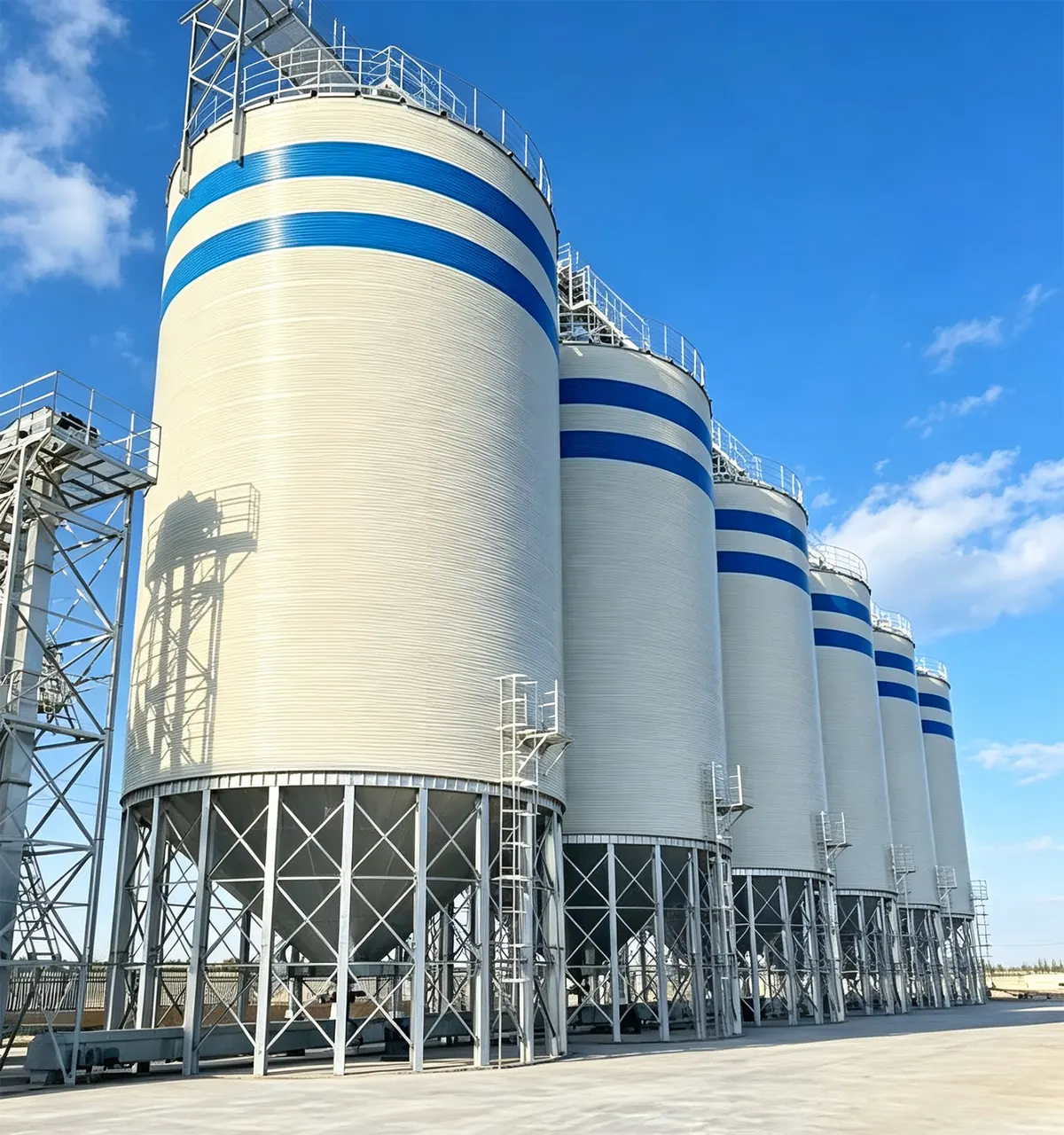
Modern soybean storage silos integrate multiple engineering systems working in concert to maintain grain quality. The foundation of effective storage lies in aeration design—the controlled movement of ambient air through the grain mass to equalize temperature and moisture.
Aeration System Specifications
Proper aeration requires airflow rates of 0.1-0.2 cubic feet per minute per bushel (CFM/bu) for cooling and 0.5-1.0 CFM/bu for drying applications. Floor-mounted duct systems with perforated surfaces distribute air uniformly across the silo cross-section. The maximum duct spacing should not exceed the grain depth to prevent dead zones where moisture accumulation occurs.
Centrifugal fans with backward-curved blades provide the static pressure necessary to overcome grain resistance. Soybeans typically require 3-5 inches of water column pressure for adequate airflow. Variable frequency drives enable operators to modulate fan speed based on ambient conditions, optimizing energy consumption while maintaining target grain temperatures.
Discharge System Considerations
Flat-bottom silos with center discharge systems offer advantages for soybean storage by promoting mass flow characteristics. This discharge pattern reduces grain segregation, minimizes residual inventory, and prevents bridging that can trap moisture and create spoilage pockets. Sweep augers with variable-speed drives ensure complete evacuation while controlling the flow rate to downstream processing equipment.
Material Selection for Soybean Silos: Preventing Corrosion and Moisture Wicking
The chemical environment within soybean storage silos presents unique material challenges. Respiration produces carbon dioxide and moisture, creating mildly acidic conditions on steel surfaces. Fatty acids migrating from damaged seeds accelerate corrosion rates, particularly at weld seams and floor-wall junctions.
Hot-dip galvanized steel with zinc coating weights of 275 g/m² or higher provides reliable corrosion protection for soybean applications. The galvanic protection mechanism ensures that minor coating damage does not compromise structural integrity. For extended service life in coastal or high-humidity environments, additional epoxy or polyurethane coatings create barrier protection against chloride-induced corrosion.
Bolted silo construction utilizing double-sealed gaskets prevents moisture infiltration through panel joints. The gasket material must maintain elasticity across temperature ranges from -30°C to 60°C to accommodate thermal expansion without creating leakage paths. Silicone-based gaskets outperform neoprene alternatives in soybean storage applications due to superior resistance to fatty acid degradation.
Material Handling and Installation: Minimizing Mechanical Damage During Filling and Discharge
Mechanical damage during filling operations establishes the baseline for storage quality deterioration. Impact velocities exceeding 20 feet per second generate visible cracking, while velocities above 30 feet per second cause internal bruising that manifests as quality defects during subsequent handling.
Engineered filling systems incorporate several damage-reduction features. Cascade spouts direct grain flow along chute surfaces rather than allowing free-fall trajectories. Impact plates with energy-absorbing rubber surfaces dissipate kinetic energy before grain contacts the silo floor. For tall silos exceeding 30 meters, telescoping fill pipes maintain maximum drop heights below 15 meters throughout the filling cycle.
Installation quality directly influences long-term storage performance. Foundation settlement exceeding 1:500 slope creates uneven loading patterns that stress silo walls and compromise discharge system alignment. Precision leveling during construction, verified with laser surveying equipment, ensures uniform grain distribution and prevents structural distortion that could create moisture infiltration points.
Smart Grain Storage: IoT Monitoring Systems for Real-Time Soybean Quality Control
Internet of Things (IoT) technology transforms soybean storage from reactive maintenance to predictive quality management. Distributed sensor networks measuring temperature, moisture, and carbon dioxide concentrations provide continuous visibility into grain condition throughout the storage volume.
Cable-based temperature monitoring systems with sensors spaced at 1.5-meter intervals detect hot spots before visible spoilage occurs. When combined with moisture sensors embedded at multiple depths, these systems identify the precise location and magnitude of quality threats. Automated alerts enable operators to initiate targeted aeration responses before deterioration becomes widespread.
Advanced monitoring platforms integrate weather forecasting data to optimize aeration scheduling. By predicting temperature and humidity trends 48-72 hours in advance, these systems activate fans during optimal ambient conditions, reducing energy consumption by 30-40% while improving cooling effectiveness. Machine learning algorithms continuously refine control strategies based on historical performance data, adapting to facility-specific characteristics.
Maintenance Best Practices: Ensuring Aeration Efficiency and Pest Prevention
Preventive maintenance protocols preserve both equipment functionality and grain quality. Aeration system inspections should verify fan belt tension, motor bearing condition, and duct integrity quarterly. Blocked or damaged distribution ducts create airflow imbalances that leave portions of the grain mass unprotected.
Grain surface monitoring identifies crusting, insect activity, or moisture accumulation requiring intervention. Pheromone traps positioned at strategic locations provide early detection of Indian meal moths and other stored-product insects before populations reach economic threshold levels. Integrated pest management combining sanitation, monitoring, and targeted fumigation minimizes chemical residues while maintaining effective control.
Silo exterior inspections should examine coating integrity, gasket condition, and structural connections. Water infiltration through compromised seals introduces moisture directly into the grain mass, creating localized spoilage that can spread throughout the inventory. Prompt repair of identified defects prevents minor issues from escalating into major quality losses.
Cost Factors and ROI: Calculating the Financial Impact of Soybean Quality Preservation
Investment in quality-focused storage infrastructure generates measurable returns through reduced shrinkage, premium market access, and extended marketing flexibility. Quality discounts for damaged soybeans typically range from $0.10 to $0.50 per bushel, with severe quality failures resulting in rejection from food-grade markets entirely.
The capital cost differential between basic and engineered storage systems typically recovers within 2-3 storage seasons through quality premium capture. Additional revenue from extended marketing windows—selling when market prices peak rather than immediately after harvest—often exceeds quality preservation benefits alone.
Energy costs for aeration and temperature management represent ongoing operational expenses. Efficient fan design, automated controls, and proper insulation reduce energy consumption to $0.01-0.03 per bushel annually. This modest investment protects inventory values that may exceed $15 per busnel in current market conditions.
How to Choose a Reliable Soybean Storage System Supplier
Selecting a storage system partner requires evaluation of engineering capability, manufacturing quality, and service support. Experienced suppliers demonstrate understanding of soybean-specific requirements including aeration rates, material compatibility, and handling sensitivities.
Manufacturing certifications including ISO 9001 quality management and structural welding certifications indicate commitment to consistent product quality. Patented technologies for sealing systems, discharge mechanisms, and structural connections differentiate suppliers offering genuine innovation versus commodity products.
Comprehensive service offerings—from site assessment and system design through installation supervision and operator training—ensure that storage investments achieve intended performance. Suppliers maintaining regional service capabilities provide responsive support when operational issues arise, minimizing downtime during critical storage periods.
Protect Your Soybean Investment with Engineered Storage Solutions
Our engineering team specializes in designing soybean storage systems that preserve quality from harvest through delivery. Contact us to discuss your specific requirements and discover how optimized storage infrastructure protects your grain value.
Request a Consultation