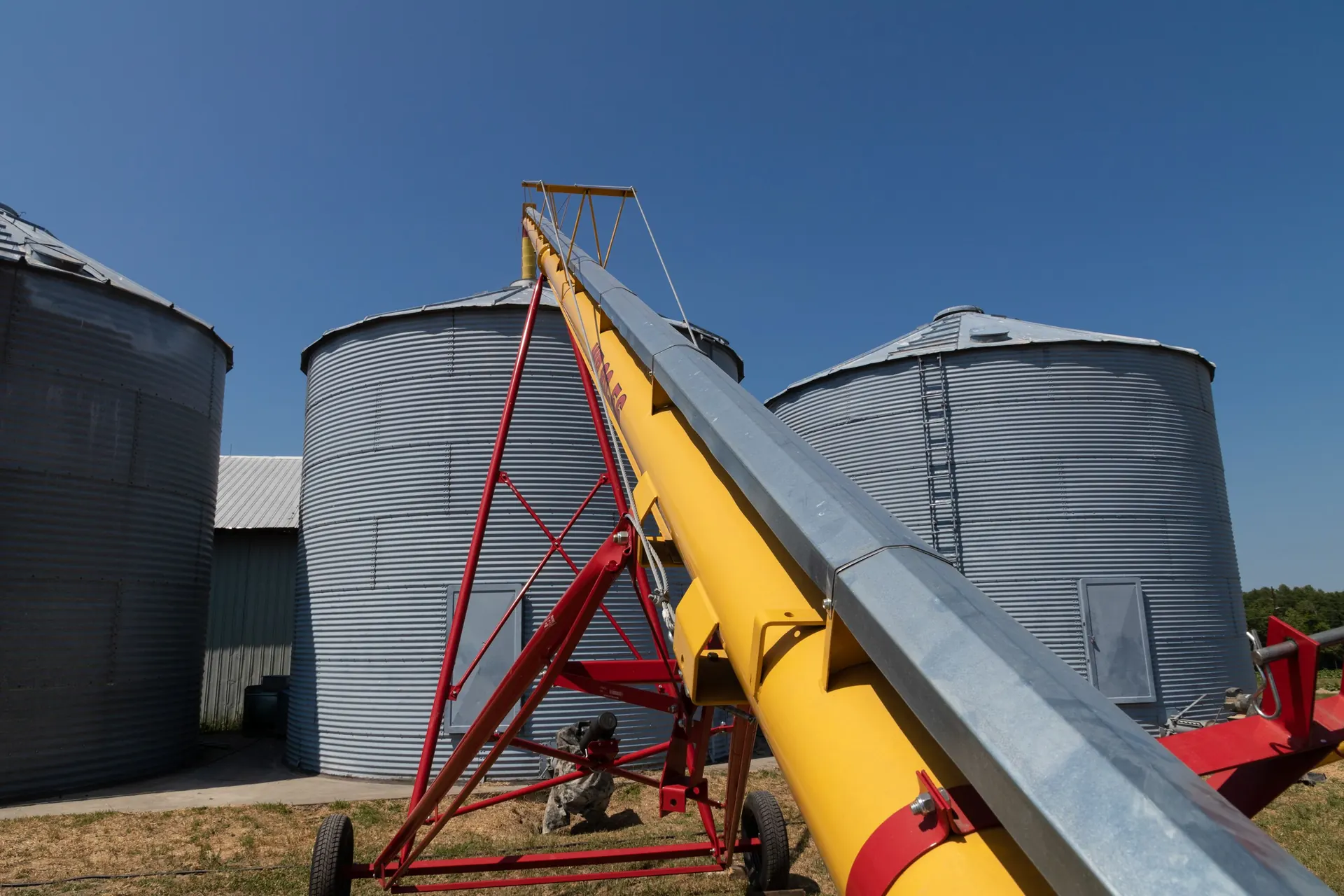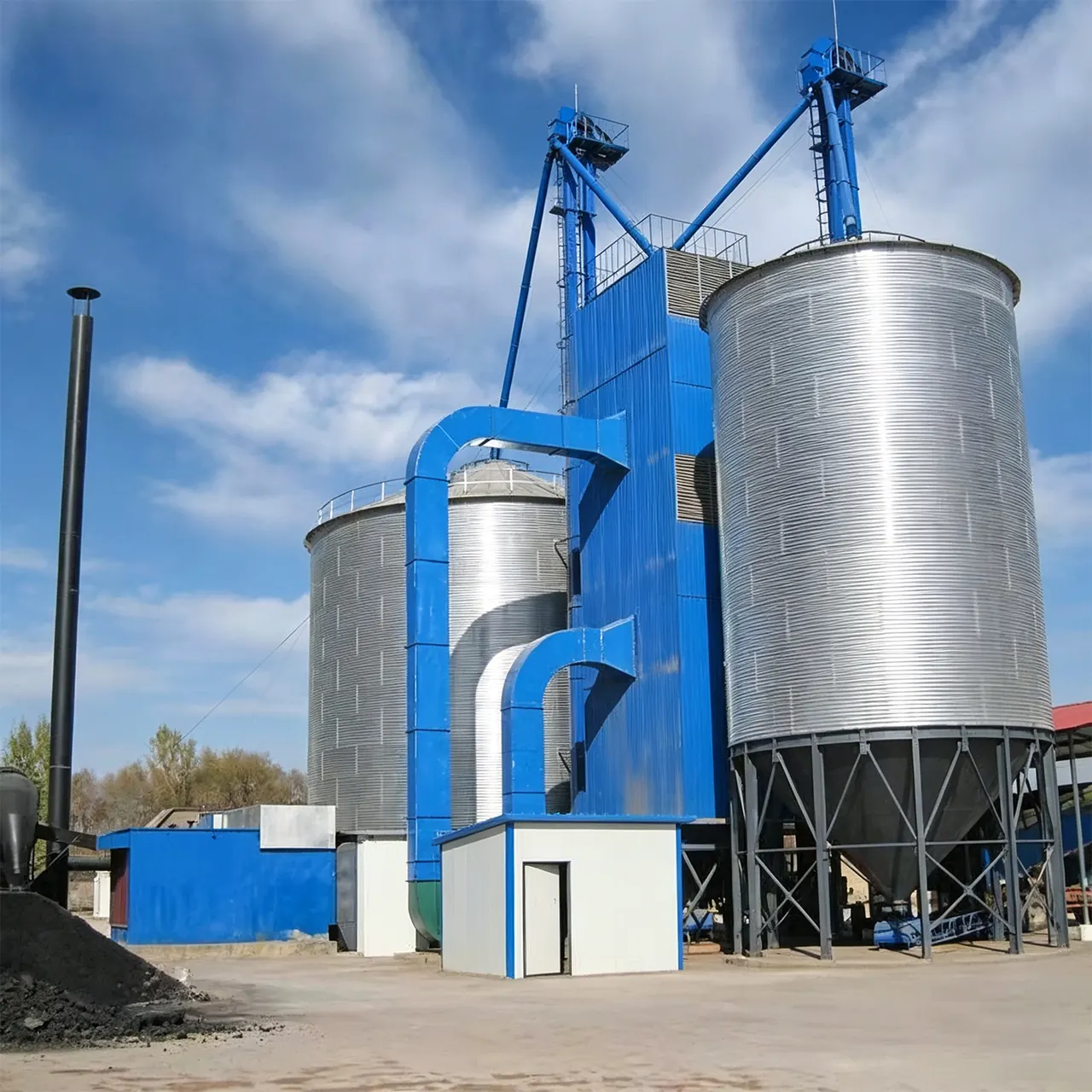
A grain silo is a thin-wall shell carrying a non-uniform, constantly shifting load — which means its vibration signature behaves nothing like a pump, fan, or gearbox. This Purchase High-Quality Steel Silo: An Engineer's Guide covers shell modes, silo quaking, accelerometer mounting practice, FFT interpretation, Eurocode load limits, and how Dry Method Cement Rotary Kiln Systems in Modern Cement Pl... IoT monitoring is changing condition-based maintenance for bulk storage assets.
Why Silo Vibration Is a Different Discipline
Most rotating-machinery vibration programmes are built around a single assumption: the machine is rigid, the mass is constant, and any change in the spectrum points to a mechanical fault. None of those assumptions hold inside a grain silo.
The structure itself is a compliant cylindrical or conical shell, typically 3 mm to 8 mm plate for a Purchase High-Quality Steel Silo: An Engineer's Guide silo in the 500 t to 5,000 t range. Its mass changes continuously as grain enters and leaves — a 3,000 t wheat silo can lose 40 % of its total dynamic mass in a single discharge cycle. The stored product is a granular medium that behaves as a solid, a fluid, or something in between depending on moisture, particle shape, and consolidation stress. And the excitation is not a rotating shaft but a sliding, ratcheting, avalanching mass of grain in contact with a corrugated or smooth wall.
The result is a system with time-varying modal properties, non-linear damping, and excitation sources that appear only during specific operational phases. Analysing it with a machinery-vibration mindset leads to false alarms, missed failures, and wasted sensor budgets. Analysing it correctly, however, yields some of the most valuable structural-health data available on a bulk handling site.
The Physics: Shell Modes, Ovalisation, and Breathing Frequencies
A cylindrical silo shell vibrates in a family of mode shapes that are classified by circumferential wave number n and axial half-wave number m.
- n = 0 (axisymmetric breathing mode): The entire circumference expands and contracts in phase. For a 10 m diameter, 6 mm wall silo, the first breathing frequency typically falls between 40 Hz and 90 Hz. Breathing modes are strongly coupled to internal pressure fluctuations and are the primary response to aeration fan pulsation.
- n = 1 (beam-bending mode): The whole silo sways as a cantilever. Fundamental frequencies for tall, slender silos (height/diameter > 3) commonly fall in the 1 Hz to 4 Hz band. This is the mode most relevant to wind and seismic response, and it is heavily influenced by the stored grain mass — a full silo can have a fundamental frequency 30–50 % lower than an empty one.
- n = 2 (ovalisation): The classic "ring" mode where the cross-section alternates between ellipse and circle. For large-diameter silos this is often the lowest-frequency shell mode, appearing between 5 Hz and 30 Hz. Ovalisation is the mode most excited by eccentric discharge and by differential settlement of the foundation.
- Higher-order n = 3, 4, 5…: Localised wall modes in the 30 Hz to 200 Hz range, strongly affected by stiffening rings, vertical stiffeners, and the corrugation pattern of the wall plate.
A useful first-order estimate for the n = 2 ovalisation frequency of an unstiffened steel cylinder is f ≈ (1/2π)·√(E·t³/(12·(1−ν²)·ρ·R⁴)), where t is wall thickness, R is radius, E is Young's modulus, ν is Poisson's ratio and ρ is density of the shell material. The practical takeaway: frequency scales with t^1.5 / R², so doubling the diameter of a silo drops its ovalisation frequency by roughly a factor of four. Large flat-bottom silos are therefore inherently low-frequency structures, and any excitation below 10 Hz deserves attention.
Silo Quaking: The Signature Nobody Expects
Silo quaking is a well-documented phenomenon in which a discharging silo emits a low-frequency rumble — typically 0.5 Hz to 10 Hz — and the structure visibly shakes. It is caused by stick-slip behaviour at the wall: grain alternately adheres to and slips against the silo wall, releasing strain energy in discrete pulses. Each slip event generates a pressure wave that propagates through the granular mass and excites the shell.
From a vibration standpoint, quaking has three distinctive characteristics:
- Narrowband, low-frequency peaks that drift in frequency as the silo empties and the effective mass changes.
- Harmonic families rather than a single tone, because the slip events are periodic but not sinusoidal.
- Strong correlation with discharge rate and wall friction, not with any rotating component.
Quaking is not usually a direct structural failure mechanism, but it accelerates fatigue at welded connections, loosens bolted flanges, and can cause cracking in the cone or hopper transition. It also generates complaints from neighbouring properties when the frequency falls in the 2–8 Hz range where building structures and human perception are most sensitive.
Accelerometer Selection and Mounting on Thin Shells
Mounting is where most silo vibration programmes fail. The rules that apply to a bearing housing do not transfer to a 5 mm steel shell.
| Mounting method | Usable frequency range | Suitability for silo shells |
|---|---|---|
| Stud / threaded pad | 2 Hz – 10 kHz+ | Best. Requires welded pad or drilled boss. Recommended for permanent installations. |
| Adhesive (cyanoacrylate / epoxy) | 2 Hz – 5 kHz | Good for temporary surveys. Clean bare metal required; grain dust destroys adhesion. |
| Rare-earth magnet | 10 Hz – 2 kHz | Acceptable for quick diagnostics only. The magnet mass loads the thin shell and shifts local modes. |
| Probe / stinger | 10 Hz – 1 kHz | Not recommended for modal work; inconsistent contact pressure. |
Three practical rules matter more than the table:
- Keep sensor mass below 5 % of the effective modal mass. On a thin shell, a 100 g accelerometer magnetically attached near an antinode can shift the local frequency by several percent and add significant damping. Use a 2 g to 5 g IEPE accelerometer where possible.
- Measure in three axes. Radial response dominates during discharge, but axial response reveals hopper and transition problems, and tangential response picks up torsional excitation from screw conveyors and rotary valves.
- Protect against the environment. Grain dust is abrasive and hygroscopic. Specify