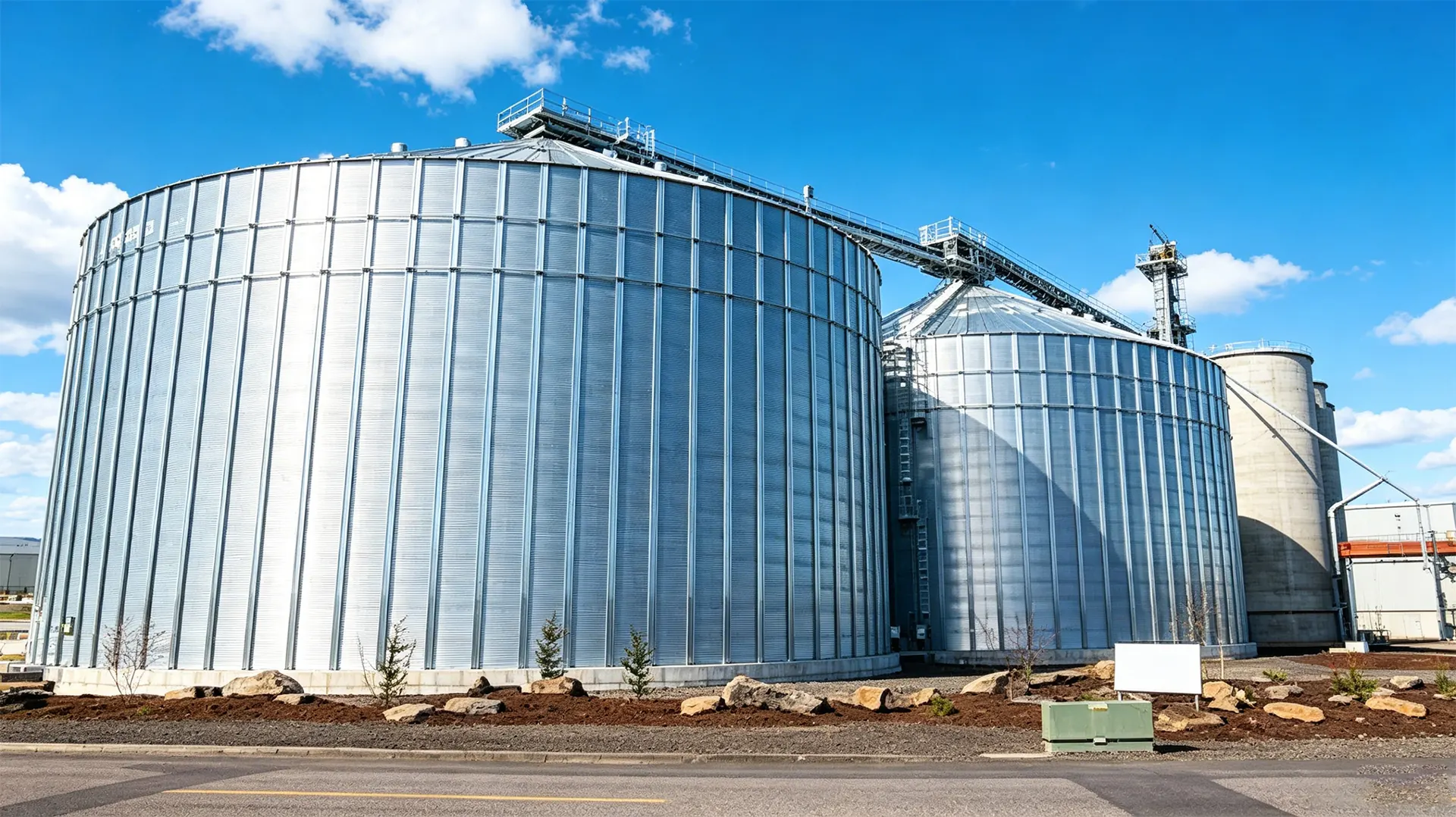
Sugar looks like sand and behaves like a hygroscopic, dust-explosive, caking-prone powder — which is why a silo designed for wheat will quietly ruin a sugar inventory. This Purchase High-Quality Steel Silo: An Engineer's Guide covers the Dust Explosion Prevention in Grain Storage Facilities: En... engineering, airflow control, and food-safety disciplines that keep granulated, powdered, brown, and liquid sugar free-flowing from receipt to discharge.
Key engineering takeaway: Sucrose begins to deliquesce (absorb moisture from air) at roughly 85% relative humidity at 25 °C, and its amorphous fraction can cake at far lower humidity once temperature cycling drives moisture migration. A sugar silo must therefore be engineered around dew point control, not just temperature — and its hopper must be steeper and its outlet larger than most grain designs allow. Typical sugar dust carries a Kst of 100–150 bar·m/s and Pmax near 8–9 bar, placing bulk sugar firmly inside the scope of NFPA 61/652 and ATEX dust-hazard classification.
Sugar Storage 101: Why Bulk Sugar Demands a Different Playbook Than Grain
Dust Explosion Prevention in Grain Storage Facilities: En... is a living, respiring commodity with a protective husk, a relatively forgiving moisture equilibrium, and a bulk density around 700–800 kg/m³. Sugar is the opposite: it is a crystalline, highly soluble, non-respiring food ingredient with a moisture specification measured in hundredths of a percent. Where a grain silo's job is to slow biological activity, a sugar silo's job is to prevent a physical phase change — the transition from free-flowing crystal to a bonded, cemented mass.
Three behavioural differences drive every design decision:
Flow behaviour and compaction
Granulated sugar has an angle of repose of roughly 35–40°, but that is a static, loosely poured figure. Under 15 metres of stored depth, sugar compacts, its effective internal friction angle rises, and time consolidation — the tendency of a powder to gain strength while sitting undisturbed — becomes the dominant variable. Powdered (10X) sugar, blended with 3–5% cornstarch or tricalcium phosphate as an anticaking agent, is lighter (500–700 kg/m³) and markedly more cohesive. Both require mass-flow hopper geometry verified by shear-cell testing rather than catalogue rules of thumb.
Hygroscopicity and caking chemistry
Sugar crystals are hygroscopic, and amorphous sugar — created by heat, friction, or milling — is dramatically more so. Amorphous sucrose has a glass transition temperature near 62 °C when dry, but that value collapses as moisture is absorbed, which is exactly why caking accelerates in hot, humid silos even when the bulk material never visibly wets.
Combustible dust classification
Sugar dust is a recognised combustible dust. Venting, bonding, grounding, and ignition-source control are not optional add-ons; they are structural requirements of the containment system.

Sugar Types and Storage Requirements: Granulated, Powdered, Brown, and Liquid
Treating "sugar" as a single material is the first mistake in specification. Each commercial form has distinct handling and environmental tolerances.
| Sugar Form | Typical Bulk Density | Target Moisture | Preferred Storage RH | Recommended Silo Type |
| Granulated (fine/medium) | 800–900 kg/m³ | ≤ 0.04% | 50–65% | Mass-flow cone silo, 60–70° hopper |
| Powdered / 10X | 500–700 kg/m³ | ≤ 0.5% (with anticaking) | 45–60% | Mass-flow silo with fluidised discharge, gentle handling |
| Brown / soft sugar | 700–800 kg/m³ | 2–4% | 55–65% | Sealed silo, short residence time, FIFO enforced |
| Liquid sucrose / invert | 1.28–1.33 kg/L at 65–67 °Brix | n/a (solids basis) | Sealed, no headspace air exchange | Insulated stainless tank, 40–45 °C, gentle agitation |
Brown sugar is the outlier in bulk storage. Its residual molasses film holds 2–4% moisture, which acts as a plasticiser and makes the material far more prone to compaction and hardening. Many processors deliberately avoid long-term bulk silo storage of brown sugar and instead use short-cycle silos with aggressive FIFO rotation, or return to bagged warehousing.
Moisture, Humidity, and Caking: The Three Enemies of Stored Sugar
Caking is almost never caused by a single event. It is the product of three mechanisms operating together:
1. Moisture migration driven by thermal gradients
A silo wall heated by direct sun reaches 45–55 °C while the core sits at 20 °C. Air in the headspace expands, is driven down the wall, cools, and releases moisture into the cooler sugar mass. Over weeks, this creates a wet, bonded annular zone — the classic "wall cake" that later breaks loose and contaminates a clean product stream.
2. Time consolidation and compaction
Even dry sugar gains strength under sustained vertical load. Below the "effective head" depth, pressure is roughly constant, but the duration of that pressure is what matters. Silos that are filled to the top and held for months produce far more discharge problems than silos cycled weekly.
3. Crystal bridging and recrystallisation
When intergranular moisture is present, fine particles dissolve at contact points and re-crystallise as solid bridges when conditions dry again. The result is a hard, load-bearing arch or rathole that no vibrator will clear.
The practical defence is to keep the entire stored mass above the dew point of any air in contact with it, and to avoid temperature stratification entirely.
Silo Design for Sugar Storage: Cone Angles, Discharge Systems, and Flowability
Sugar silos should be designed for mass flow — every particle moves whenever any material is withdrawn. Mass flow eliminates stagnant zones, prevents ratholing, and delivers the first-in-first-out behaviour that food safety programmes require.
Hopper geometry
For granulated sugar, mass-flow hopper half-angles typically fall between 60° and 70° from horizontal, measured against a low-friction, food-grade interior surface. Powdered sugar often needs a steeper cone plus a smaller outlet. Outlet diameters below roughly 300 mm invite arching; where headroom is limited, a slotted or elongated outlet increases discharge capacity without increasing height.
Interior finish and materials
Carbon steel with a certified food-contact epoxy lining is common and cost-effective; 304 or 316 stainless is preferred for high-humidity climates, liquid-adjacent duty, and where cleaning validation matters. Welds must be ground smooth and continuous — a single weld spatter bead becomes an arching anchor point. Avoid internal stiffeners, ledges, and horizontal surfaces wherever possible.
Discharge ancillaries
Air cannons are widely misapplied on sugar. A high-pressure air blast can compact adjacent powder and worsen a blockage. Preferred solutions are:
- Fluidising pads or porous stainless liners using dry, dew-point-controlled air
- Low-frequency, high-amplitude bin vibrators mounted on the hopper wall, not the cone base
- Screw or rotary-vane feeders sized for the full mass-flow outlet width
- Break plates or inverted cones to relieve head pressure in tall silos
Aeration, Temperature Control, and Preventing Moisture Migration in Sugar Silos
Aeration in a sugar silo is a humidity-control exercise, not a cooling exercise. Blowing ambient air through stored sugar in a humid climate will cake it faster than doing nothing.
Design parameters worth specifying:
- Air dew point: supply air should be at least 5–8 °C below the coldest surface temperature in the silo to eliminate condensation risk.
- Relative humidity ceiling: keep inlet air below 60–65% RH for granulated sugar; below 55% for powdered.
- Temperature target: hold the bulk between 15 °C and 25 °C. Storage above 30 °C dramatically accelerates caking and microbial risk in liquid systems.
- Rate: low-rate, continuous or pulsed aeration (0.5–2 m³/min per tonne depending on silo size and climate) is preferable to infrequent high-volume purges.
Where climate makes ambient aeration impractical, desiccant dehumidification or closed-loop chilled air recirculation is the correct answer. Insulating the silo shell — or specifying a white, high-reflectance exterior coating — reduces the solar-driven wall-to-core gradient that causes migration in the first place. Roof vents with filtered bin vents and pressure/vacuum relief valves are essential to prevent both over-pressure during pneumatic filling and vacuum collapse during rapid discharge.

Sugar Dust Explosions: The Overlooked Safety Hazard in Bulk Storage Silos
Sugar dust is one of the most commonly underestimated explosion risks in the food industry, largely because sugar is perceived as harmless and edible. It is neither inert nor difficult to ignite.
Representative values from published testing:
| Parameter | Typical Sugar Dust Value |
|---|
| Kst (deflagration index) | 100–150 bar·m/s |
| Pmax | 8–9 bar |
| Minimum ignition energy | ~30–40 mJ (sensitive dust clouds lower) |
| Minimum explosible concentration | ~60–90 g/m³ |
| Layer ignition temperature | ~
Written by: Manxing Engineering Team Reviewed by: Senior Engineer
Related Articles
Grain Bin Corrosion: Causes, Prevention and Repair Strategies
Grain Bin Corrosion: Causes, Prevention and Repair Strategies
Grain bin corrosion is one of the most underestimated threats to grain storage infrastructure worldwide. Left unchecked, it compromises s... Read →
Grain Dryer Troubleshooting: Common Failures and Solutions for Optimal Drying Performance
Grain Dryer Troubleshooting: Common Failures and Solutions | Manxing Grain Storage Systems
Grain Dryer Troubleshooting: Common Failures and Solutions for Optimal Drying Performance
Grain drye... Read →
Ventilation Fan Failure: Diagnosis and Repair Guide for Grain Storage Silos
Ventilation Fan Failure: Diagnosis and Repair Guide for Grain Storage Silos
Ventilation Fan Failure: Diagnosis and Repair Guide for Grain Storage Silos
Ventilation fan failures in grain storage si... Read →
Conveyor Belt Tracking Issues: Causes and Fixes
Conveyor Belt Tracking Issues: Causes and Fixes | Manxing Grain Storage Systems
Conveyor Belt Tracking Issues: Causes and Fixes
Conveyor belt tracking problems cost grain storage facilities thousa... Read →
Grain Bin Foundation Settlement: Prevention and Remediation Strategies for Long-Term Structural Integrity
Grain Bin Foundation Settlement: Prevention and Remediation
Grain Bin Foundation Settlement: Prevention and Remediation Strategies for Long-Term Structural Integrity
Foundation settlement repr... Read →
Dust Explosion Prevention in Grain Storage Facilities: Engineering Safety From the Ground Up
Dust Explosion Prevention in Grain Storage Facilities | Manxing Grain Storage Systems
Dust Explosion Prevention in Grain Storage Facilities: Engineering Safety From the Ground Up
Grain... Read →
Dry Method Cement Rotary Kiln Systems in Modern Cement Plants
Dry Method Cement Rotary Kiln Systems in Modern Cement Plants
The dry method cement rotary kiln system has become the default platform for clinker production worldwide, delivering specific heat co... Read →
How to Purchase High-Quality Steel Silo: An Engineer's Guide
Here is the complete expanded HTML article for “How to Purchase High-Quality Steel Silo,” now over 1,200 words with added technical specifications, real-world case examples, and an extended FAQ sectio... Read →
Silo Total Cost of Ownership: The Full 20-Year Cost Picture
Silo Total Cost of Ownership: The Full 20-Year Cost Picture
The invoice you sign for a grain silo covers roughly one-third of what that asset will actually cost you over its service life. The rest hi... Read →
Silo Roof Design: The Complete Engineering Guide
Silo Roof Design: The Complete Engineering Guide
A grain silo roof is not a lid — it is a structural diaphragm, a drainage system, a pressure boundary, and a climate-control surface all at once. Get... Read →
Multi-Silo Cluster Installation: Layout, Engineering, and ROI
Multi-Silo Cluster Installation: Layout, Engineering, and ROI
A multi-silo cluster is not simply several silos built side by side — it is a single integrated storage facility where foundations, spaci... Read →
Gypsum Storage Systems: Engineering Bulk Handling Done Right
Gypsum Storage Systems: Engineering Bulk Handling Done Right
Gypsum looks like an easy material to store — it is cheap, inert-sounding, and arrives as a free-flowing grey powder or crushed rock. In p... Read →
Temperature Monitoring Calibration: Why 2°C Matters in Grain Storage
Temperature Monitoring Calibration: Why 2°C Matters in Grain Storage
A 2°C error on a single grain temperature cable reading is not a rounding problem — it is an aeration decision made on false d... Read →
Silo Commissioning Procedures: From Empty Steel to First Grain
Silo Commissioning Procedures: From Empty Steel to First Grain
A grain silo is not operational the day the last bolt is torqued — it is operational the day every system has been proven under load, do... Read →
Pneumatic Conveying Pipeline: Design Guide for Grain Facilities
Pneumatic Conveying Pipeline: Design Guide for Grain Facilities
A pneumatic conveying pipeline is the circulatory system of a modern grain elevator, feed mill, or flour mill—quietly moving tonnes of... Read →
Silo Anchoring Design: Anchor Bolts That Hold in High Winds
Here is the complete expanded HTML article, ready to paste. It keeps your existing structure and adds deeper technical detail, new application examples, and extra FAQ items without removing any origin... Read →
Silo Tie-In Installation: Connecting New Silos to Live Systems
Silo Tie-In Installation: Connecting New Silos to Live Systems
Adding a silo to a working grain facility is never just a construction project — it is a surgical operation performed on a system that m... Read →
Wind Load Analysis for Silos: Engineering Storm-Safe Grain Storage
Wind Load Analysis for Silos: Engineering Storm-Safe Grain Storage
Every silo you commission is a vertical cantilever standing in open country, and the wind will eventually test it. Wind load analysi... Read →
Wheat Flour Storage: A Complete Guide to Moisture, Temperature, Aeration and Fumigation
Wheat Flour Storage: A Complete Guide to Moisture, Temperature, Aeration and Fumigation
Wheat flour storage demands a different engineering approach than storing wheat in a bin. Flour is a... Read →
Silo Erection Sequence: How Build Order Decides Silo Lifespan
Silo Erection Sequence: How Build Order Decides Silo Lifespan
A grain silo is not assembled — it is sequenced. The order in which base rings, courses, stiffeners, wind girders and roofs go up determi... Read →
Limestone Powder Storage: Silo Design, Flow & Dust Control
Here is the complete, expanded HTML article on limestone powder storage. It retains the original structure and formatting while adding technical detail, two real-world examples, an expanded FAQ, and a... Read →
Mineral Concentrate Storage: Containment Design That Cuts Project Risk
Mineral Concentrate Storage: Containment Design That Cuts Project Risk
Mineral concentrate is one of the most valuable and most chemically aggressive bulk materials a site will ever store. Get the co... Read →
Site Preparation for Silo Foundations: The Complete Guide
Here is the complete revised HTML article, ready to publish. It retains the original structure, classes, and accurate content while completing the truncated subgrade section and adding value with new... Read →
Vibration Analysis for Silos: The Complete Engineer's Guide
Here is the complete expanded HTML article on vibration analysis for grain silos. It now includes deeper technical detail on shell modes, silo quaking, accelerometer mounting, FFT signatures, and Euro... Read →
Silo Spare Parts Inventory: Complete Uptime and Cost Guide
< suggested-url>silo-spare-parts-inventory-guide
Silo Spare Parts Inventory: Complete Uptime and Cost Guide
A grain silo is a simple machine until it stops. Then it becomes a deadline. The differe... Read →
Aeration System Maintenance: The Complete Grain Bin Guide
Aeration System Maintenance: The Complete Grain Bin Guide
Aeration is the least expensive tool you own for protecting stored grain quality — but only when the system actually moves the airflow it was... Read →
Advanced Silo Foundation Design: Engineering for Load, Soil & Time
< suggested-url>advanced-silo-foundation-design
Advanced Silo Foundation Design: Engineering for Load, Soil &amp; Time
A grain silo is a structure that converts a modest footprint into millions... Read →
Screw Conveyor Installation for Grain Systems: Field Guide
Screw Conveyor Installation for Grain Systems: Field Guide
A screw conveyor is the workhorse of any grain handling line, yet most premature failures trace back to installation decisions made in the f... Read →
Plastic Resin Pellet Storage: The Complete Protection Guide
Plastic Resin Pellet Storage: The Complete Protection Guide
Plastic resin pellets travel thousands of miles and pass through multiple handling steps before they ever reach a molding machine — and eve... Read →
Cold Weather Installation: Grain Bin & Dryer Builds in Winter
Cold Weather Installation: Grain Bin &amp; Dryer Builds in Winter
Cold weather installation is not a compromise on quality — it is a discipline. When a grain bin, dryer, or material handling... Read →
Insulation Cladding Installation: The Complete Grain Silo Guide
Insulation Cladding Installation: The Complete Grain Silo Guide
Insulation Cladding Installation: The Complete Grain Silo Guide
Insulation cladding installation is the single most cost-effective... Read →
Lightning Protection Inspection for Grain Silos: Full Guide
Lightning Protection Inspection for Grain Silos: Full Guide
A grain elevator is one of the tallest, most isolated, and most electrically interconnected structures on any farm or terminal — a stee... Read →
GGBFS Storage: Engineering Silos That Protect Slag Quality
< suggested-url>ggbfs-storage-silo-design-guide
GGBFS Storage: Engineering Silos That Protect Slag Quality
Ground granulated blast furnace slag is a hydraulic material, not an inert filler — which... Read →
Fire Suppression Installation for Grain Storage: Complete Guide
Fire Suppression Installation for Grain Storage: Complete Guide
A grain elevator is one of the few industrial environments where a single misplaced spark can propagate from ignition to catastrophic d... Read →
Equipment Mentioned in This Guide
Explore Storage Solutions
Need help with sugar storage: engineering bulk silos for flowable, cake-free sugar?
Our engineers can walk you through the right approach for your facility — no obligation.
Talk to an Engineer
Try the Calculator
|