Mon–Sat 8:00–20:00
Products ▸
Solutions ▸
Industries ▸
Projects
Knowledge ▸
Resources ▸
Tools About FAQ Contact

Insulation Cladding Installation: The Complete Grain Silo Guide

Insulation Cladding Installation: The Complete Grain Silo Guide Insulation Cladding Installation: The Complete Grain Silo Guide Insulation cladding installation is the single most cost-effective...

8 min read · Last updated: Oct 6, 2026

TL;DR: Insulation Cladding Installation: The Complete Grain Silo Guide Insulation Cladding Installation: The Complete Grain Silo Guide Insulation cladding installation is the single most cost-effective...

Insulation cladding installation is the single most cost-effective intervention available to grain storage operators who need to stop condensation, hold grain quality through seasonal swings, and extend the service life of bins, Different Types of Silos Used in Cement, Mining & Agr..., and drying systems. Get the detailing right and the asset performs for 30 years; get the laps, fasteners, or penetrations wrong and you will be repairing corrosion and spoiled grain within three seasons.

Key Engineering Takeaway

A Purchase High-Quality Steel Silo: An Engineer's Guide sheet expands and contracts at approximately 0.012 mm per metre per °C. On a 20 m silo wall facing a 50 °C annual surface temperature swing, that is roughly 12 mm of movement that must be absorbed by correctly positioned expansion joints — not resisted by over-tightened fasteners. Thermal movement, not wind, is the most common cause of premature cladding failure on wide-span grain roofs.

Why Insulation Cladding Matters More Than You Think: Condensation Control, Thermal Efficiency, and Structural Longevity

Most operators approach cladding as a weatherproofing exercise. In grain storage, it is fundamentally a moisture management exercise. Bare Purchase High-Quality Steel Silo: An Engineer's Guide silo walls and roofs behave as highly efficient thermal bridges. On a cool autumn night, the internal steel surface can sit 4–8 °C below the interstitial air temperature. When that surface drops below the dew point of the headspace air — which is common during the diurnal cycle after a warm day's aeration — condensation forms directly above the grain mass. Water then drips onto the grain surface, creating the classic caking, crusting, and mould pocket that leads to rejection loads.

Insulation cladding addresses this in three ways simultaneously:

  • Thermal break: Continuous insulation raises the internal surface temperature above the dew point, eliminating the cold surface that drives condensation.
  • Vapour control: A correctly positioned vapour control layer, combined with sealed laps, keeps moist internal air out of the insulation cavity, protecting the thermal performance of the insulation itself.
  • Corrosion protection: A drained and ventilated cavity allows incidental moisture to escape rather than pooling against the structural steel — the mechanism behind most silo wall perforation.

There is also a genuine energy dividend. Insulated drying bins and silos hold plenum temperatures more stably, reduce heater cycling, and cut aeration runtime. In continuous-flow drying systems, insulated plenums and ductwork reduce heat loss between the burner and the grain column, which directly improves drying efficiency and grain quality.

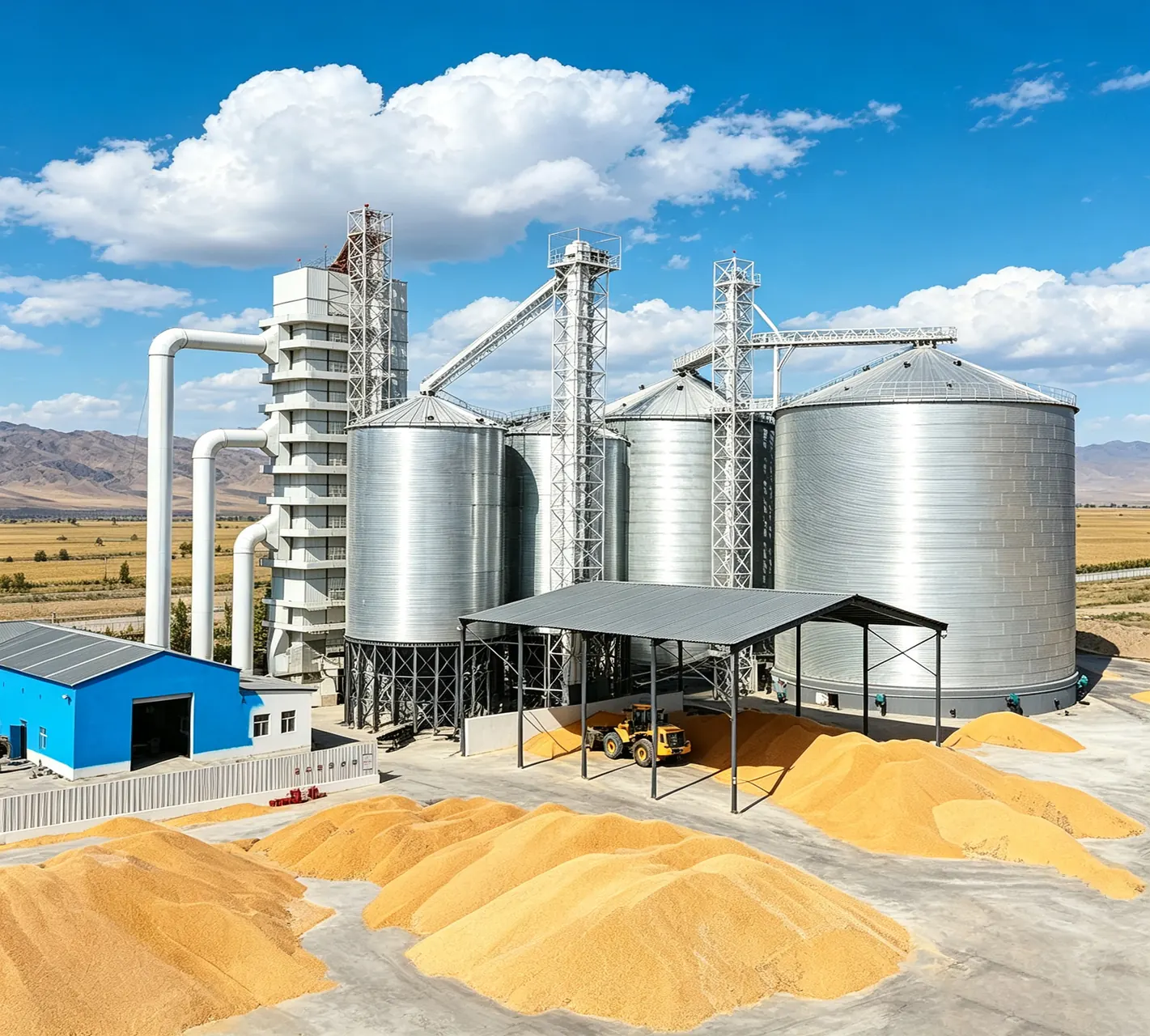
Technicians installing insulated cladding panels on a grain storage silo wall with fall protection harnesses in place

Cladding Materials and Profiles Compared: Trapezoidal, Standing Seam, Micro-Rib, and Insulated Sandwich Panels

Profile selection drives the whole installation sequence. Each system has a different lap strategy, fixing density, and tolerance to thermal movement.

Profile Type Typical Use on Grain Assets Lap Strategy Fixing Density Thermal Movement Tolerance
Trapezoidal (33/1000, 35/1000) Silo walls, duct covers, side cladding One-rib side lap, sealed with butyl tape High — 300 mm at edges, 450–500 mm field Moderate; requires stitch screws at laps
Standing seam Wide-span silo roofs, large drying buildings Mechanically seamed, no through-fasteners in the pan Low — concealed clips Excellent; clips allow longitudinal slide
Micro-rib / corrugated liner Internal liners, smooth-face applications Single or double rib lap Medium Good; low profile handles small movements
Insulated sandwich panel (PIR/PUR/mineral wool core) Flat-sided silos, dryer buildings, control rooms Interlocking tongue-and-groove with factory seals Concealed or face-fixed, 500 mm typical Good, provided panel joints are not over-restrained

For grain-specific environments, substrate specification matters as much as profile. Galvanised coatings in the Z275 or AZ150 range, or coil-coated steel with a PVDF or polyester finish, deliver materially longer service life in dust-laden, fumigant-exposed conditions. On ammonia-rich sites — fertiliser blending areas, for example — stainless steel fasteners in A2 or A4 grade are non-negotiable.

Pre-Installation Site Survey: Substrate Condition, Moisture Mapping, and Thermal Bridging Audit

No cladding should be installed before a documented survey. Three checks matter above all others.

Substrate Condition

Assess the existing structure for section loss, coating breakdown, and fastener corrosion. Hammer-test or ultrasonic-thickness-test the silo wall at representative elevations. Any substrate below 80% of original section should be repaired or reinforced before cladding is applied — you are encapsulating the structure, and hidden deterioration becomes expensive deterioration.

Moisture Mapping

Use a calibrated pin or capacitance moisture meter on the substrate and on adjacent concrete plinths. Record readings on a grid and mark wet zones. Installing cladding over a damp substrate traps that moisture permanently. Where readings exceed acceptable thresholds, allow drying time or introduce a drained, ventilated cavity with weep details at the base.

Thermal Bridging Audit

Map every structural penetration: purlin connections, wall ties, stiffener plates, access ladders, and roof walkway brackets. Each is a conductive path that will produce a cold spot and, in the right conditions, a condensation drip point. Insulation must be continuous across these elements, or a proprietary thermal break pad must be introduced.

The Dew Point Factor: How Cladding Detailing Prevents Condensation and Grain Spoilage Inside Bins and Silos

The dew point is the design driver. Determine the internal design temperature and relative humidity of the headspace, then calculate the dew point. Your cladding build-up must keep the internal surface temperature above that figure across the full annual range.

Practically, this means the vapour control layer goes on the warm (internal) side of the insulation, all laps are taped or sealed with a compatible membrane adhesive, and the outer cladding is ventilated so that any moisture which does enter can escape. Reversing this order — a vapour barrier on the cold side — is one of the most common and most damaging installation errors we see on retrofitted bins.

Two additional details complete the dew point strategy:

  • Roof-to-wall junctions: The eaves are the coldest point of the envelope and the most common drip location. Use insulated eaves closures, not open-profile foam fillers alone.
  • Headspace ventilation: Where grain is stored warm and the ambient air is cold, controlled ventilation of the headspace reduces moisture accumulation far more effectively than increasing insulation thickness.

Tools, Fasteners, and Fall Protection: Setting Up for Safe, Accurate Cladding Work at Height

Cladding work on a silo is high-risk, repetitive, and quality-critical. A properly resourced crew carries:

  • Self-drilling screws with bonded EPDM washers, correct length for total build-up, in coated carbon steel (C4/C5 environment) or A2/A4 stainless
  • Variable-torque screw guns with depth-sensitive nose cones — over-driving compresses the washer and destroys the seal
  • Nibblers, profile shears, and hand seamers — never angle grinders
  • Butyl sealant tape, neutral-cure silicone, EPDM closure strips, and profile-matched flashings
  • Fall protection: guardrails, anchor points, or a certified horizontal lifeline system, plus harnesses for every operative

Fastener torque discipline is the single biggest quality variable on site. A washer compressed to roughly 25–30% of its original thickness forms a reliable seal; a washer squeezed flat has already failed. Where possible, run a pull-out test on a sample fixing to confirm the substrate gauge will support the design wind uplift load.

Close-up detail of a self-drilling cladding fastener with bonded EPDM washer correctly torqued on a corrugated steel sheet

Step-by-Step Insulation Cladding Installation: Fixing, Lapping, Sealing, and Flashing Sequence

Sequence control is everything. Work from the bottom up and from the prevailing windward end across the structure.

  1. Set out and datum: Establish a base line and check sheet module against the structure. Never allow a cut sheet narrower than 200 mm at an edge — it will oil-can and fail.
  2. Install the vapour control layer: Continuous, lapped a minimum of 100 mm, taped, and dressed into flashings at penetrations before cladding begins.
  3. Fix the first sheet: Position, check plumb, and fix at the leading edge. Verify before committing the run.
  4. Lap and seal: Side laps sealed with butyl tape for exposed conditions; end laps a minimum of 150 mm, sealed and stitch-fixed through the lap at 300 mm centres.
  5. Progress across the run: Maintain consistent fastener spacing — 300 mm at sheet ends, 450–500 mm in the field. Drive every fastener square to the sheet.
  6. Install flashings: Ridge, verge, eaves, corner, and base flashings last, always lapped so water sheds outward and downward. Apply sealant in a continuous bead, never in dots.
  7. Final inspection: Walk the installation before demobilising, checking every lap, fastener, and flashing.

On-Site Cutting, Bending, and Forming Without Damaging Protective Coatings

Coil-coated and galvanised sheets are only as good as their intact coating. Cutting with an abrasive disc burns the coating and throws hot swarf that embeds in the surface and rusts within weeks — leaving a trail of brown staining down a brand-new silo. Use nibblers or profile shears for straight cuts and hand or powered seamers for bends.

Cut edges on galvanised material should be dressed with a zinc-rich touch-up coating. Never cut sheets on top of a completed roof; cut at ground level or on a designated cutting table, and sweep the roof clean at the end of every shift. Store sheets on edge, with timber bearers, and never drag them across each other — sliding contact removes the coating in the contact zone.

Thermal Movement and Expansion Joints: Detailing Wide-Span Roofs, Walls, and Movement Joints Correctly

Long, continuous cladding runs must be broken. As a rule of thumb, introduce a movement joint at intervals that keep total movement within the tolerance of the fixing system — commonly every 12–15 m for exposed steel cladding, and at every structural movement joint in the building. Standing seam systems handle movement through sliding clips and require careful detailing
Written by: Manxing Engineering Team

Reviewed by: Senior Engineer

Related Articles

Grain Bin Corrosion: Causes, Prevention and Repair Strategies

Grain Bin Corrosion: Causes, Prevention and Repair Strategies

Grain Bin Corrosion: Causes, Prevention and Repair Strategies Grain bin corrosion is one of the most underestimated threats to grain storage infrastructure worldwide. Left unchecked, it compromises s...

Read →
Grain Dryer Troubleshooting: Common Failures and Solutions for Optimal Drying Performance

Grain Dryer Troubleshooting: Common Failures and Solutions for Optimal Drying Performance

Grain Dryer Troubleshooting: Common Failures and Solutions | Manxing Grain Storage Systems Grain Dryer Troubleshooting: Common Failures and Solutions for Optimal Drying Performance Grain drye...

Read →
Ventilation Fan Failure: Diagnosis and Repair Guide for Grain Storage Silos

Ventilation Fan Failure: Diagnosis and Repair Guide for Grain Storage Silos

Ventilation Fan Failure: Diagnosis and Repair Guide for Grain Storage Silos Ventilation Fan Failure: Diagnosis and Repair Guide for Grain Storage Silos Ventilation fan failures in grain storage si...

Read →
Conveyor Belt Tracking Issues: Causes and Fixes

Conveyor Belt Tracking Issues: Causes and Fixes

Conveyor Belt Tracking Issues: Causes and Fixes | Manxing Grain Storage Systems Conveyor Belt Tracking Issues: Causes and Fixes Conveyor belt tracking problems cost grain storage facilities thousa...

Read →
Grain Bin Foundation Settlement: Prevention and Remediation Strategies for Long-Term Structural Integrity

Grain Bin Foundation Settlement: Prevention and Remediation Strategies for Long-Term Structural Integrity

Grain Bin Foundation Settlement: Prevention and Remediation Grain Bin Foundation Settlement: Prevention and Remediation Strategies for Long-Term Structural Integrity Foundation settlement repr...

Read →
Dust Explosion Prevention in Grain Storage Facilities: Engineering Safety From the Ground Up

Dust Explosion Prevention in Grain Storage Facilities: Engineering Safety From the Ground Up

Dust Explosion Prevention in Grain Storage Facilities | Manxing Grain Storage Systems Dust Explosion Prevention in Grain Storage Facilities: Engineering Safety From the Ground Up Grain...

Read →
Dry Method Cement Rotary Kiln Systems in Modern Cement Plants

Dry Method Cement Rotary Kiln Systems in Modern Cement Plants

Dry Method Cement Rotary Kiln Systems in Modern Cement Plants The dry method cement rotary kiln system has become the default platform for clinker production worldwide, delivering specific heat co...

Read →

How to Purchase High-Quality Steel Silo: An Engineer's Guide

Here is the complete expanded HTML article for “How to Purchase High-Quality Steel Silo,” now over 1,200 words with added technical specifications, real-world case examples, and an extended FAQ sectio...

Read →

Silo Total Cost of Ownership: The Full 20-Year Cost Picture

Silo Total Cost of Ownership: The Full 20-Year Cost Picture The invoice you sign for a grain silo covers roughly one-third of what that asset will actually cost you over its service life. The rest hi...

Read →

Silo Roof Design: The Complete Engineering Guide

Silo Roof Design: The Complete Engineering Guide A grain silo roof is not a lid — it is a structural diaphragm, a drainage system, a pressure boundary, and a climate-control surface all at once. Get...

Read →

Multi-Silo Cluster Installation: Layout, Engineering, and ROI

Multi-Silo Cluster Installation: Layout, Engineering, and ROI A multi-silo cluster is not simply several silos built side by side — it is a single integrated storage facility where foundations, spaci...

Read →

Gypsum Storage Systems: Engineering Bulk Handling Done Right

Gypsum Storage Systems: Engineering Bulk Handling Done Right Gypsum looks like an easy material to store — it is cheap, inert-sounding, and arrives as a free-flowing grey powder or crushed rock. In p...

Read →

Temperature Monitoring Calibration: Why 2°C Matters in Grain Storage

Temperature Monitoring Calibration: Why 2°C Matters in Grain Storage A 2°C error on a single grain temperature cable reading is not a rounding problem — it is an aeration decision made on false d...

Read →

Silo Commissioning Procedures: From Empty Steel to First Grain

Silo Commissioning Procedures: From Empty Steel to First Grain A grain silo is not operational the day the last bolt is torqued — it is operational the day every system has been proven under load, do...

Read →

Pneumatic Conveying Pipeline: Design Guide for Grain Facilities

Pneumatic Conveying Pipeline: Design Guide for Grain Facilities A pneumatic conveying pipeline is the circulatory system of a modern grain elevator, feed mill, or flour mill—quietly moving tonnes of...

Read →

Silo Anchoring Design: Anchor Bolts That Hold in High Winds

Here is the complete expanded HTML article, ready to paste. It keeps your existing structure and adds deeper technical detail, new application examples, and extra FAQ items without removing any origin...

Read →

Silo Tie-In Installation: Connecting New Silos to Live Systems

Silo Tie-In Installation: Connecting New Silos to Live Systems Adding a silo to a working grain facility is never just a construction project — it is a surgical operation performed on a system that m...

Read →

Wind Load Analysis for Silos: Engineering Storm-Safe Grain Storage

Wind Load Analysis for Silos: Engineering Storm-Safe Grain Storage Every silo you commission is a vertical cantilever standing in open country, and the wind will eventually test it. Wind load analysi...

Read →

Wheat Flour Storage: A Complete Guide to Moisture, Temperature, Aeration and Fumigation

Wheat Flour Storage: A Complete Guide to Moisture, Temperature, Aeration and Fumigation Wheat flour storage demands a different engineering approach than storing wheat in a bin. Flour is a...

Read →

Silo Erection Sequence: How Build Order Decides Silo Lifespan

Silo Erection Sequence: How Build Order Decides Silo Lifespan A grain silo is not assembled — it is sequenced. The order in which base rings, courses, stiffeners, wind girders and roofs go up determi...

Read →

Limestone Powder Storage: Silo Design, Flow & Dust Control

Here is the complete, expanded HTML article on limestone powder storage. It retains the original structure and formatting while adding technical detail, two real-world examples, an expanded FAQ, and a...

Read →

Mineral Concentrate Storage: Containment Design That Cuts Project Risk

Mineral Concentrate Storage: Containment Design That Cuts Project Risk Mineral concentrate is one of the most valuable and most chemically aggressive bulk materials a site will ever store. Get the co...

Read →

Site Preparation for Silo Foundations: The Complete Guide

Here is the complete revised HTML article, ready to publish. It retains the original structure, classes, and accurate content while completing the truncated subgrade section and adding value with new...

Read →

Vibration Analysis for Silos: The Complete Engineer's Guide

Here is the complete expanded HTML article on vibration analysis for grain silos. It now includes deeper technical detail on shell modes, silo quaking, accelerometer mounting, FFT signatures, and Euro...

Read →

Silo Spare Parts Inventory: Complete Uptime and Cost Guide

< suggested-url>silo-spare-parts-inventory-guide Silo Spare Parts Inventory: Complete Uptime and Cost Guide A grain silo is a simple machine until it stops. Then it becomes a deadline. The differe...

Read →

Aeration System Maintenance: The Complete Grain Bin Guide

Aeration System Maintenance: The Complete Grain Bin Guide Aeration is the least expensive tool you own for protecting stored grain quality — but only when the system actually moves the airflow it was...

Read →

Advanced Silo Foundation Design: Engineering for Load, Soil &amp; Time

< suggested-url>advanced-silo-foundation-design Advanced Silo Foundation Design: Engineering for Load, Soil &amp;amp; Time A grain silo is a structure that converts a modest footprint into millions...

Read →

Sugar Storage: Engineering Bulk Silos for Flowable, Cake-Free Sugar

Sugar Storage: Engineering Bulk Silos for Flowable, Cake-Free Sugar Sugar looks like sand and behaves like a hygroscopic, dust-explosive, caking-prone powder — which is why a silo designed for wheat...

Read →

Screw Conveyor Installation for Grain Systems: Field Guide

Screw Conveyor Installation for Grain Systems: Field Guide A screw conveyor is the workhorse of any grain handling line, yet most premature failures trace back to installation decisions made in the f...

Read →

Plastic Resin Pellet Storage: The Complete Protection Guide

Plastic Resin Pellet Storage: The Complete Protection Guide Plastic resin pellets travel thousands of miles and pass through multiple handling steps before they ever reach a molding machine — and eve...

Read →

Cold Weather Installation: Grain Bin &amp; Dryer Builds in Winter

Cold Weather Installation: Grain Bin &amp;amp; Dryer Builds in Winter Cold weather installation is not a compromise on quality — it is a discipline. When a grain bin, dryer, or material handling...

Read →

Lightning Protection Inspection for Grain Silos: Full Guide

Lightning Protection Inspection for Grain Silos: Full Guide A grain elevator is one of the tallest, most isolated, and most electrically interconnected structures on any farm or terminal — a stee...

Read →

GGBFS Storage: Engineering Silos That Protect Slag Quality

< suggested-url>ggbfs-storage-silo-design-guide GGBFS Storage: Engineering Silos That Protect Slag Quality Ground granulated blast furnace slag is a hydraulic material, not an inert filler — which...

Read →

Fire Suppression Installation for Grain Storage: Complete Guide

Fire Suppression Installation for Grain Storage: Complete Guide A grain elevator is one of the few industrial environments where a single misplaced spark can propagate from ignition to catastrophic d...

Read →

Equipment Mentioned in This Guide

Explore Storage Solutions

Need help with insulation cladding installation: the complete grain silo guide?

Our engineers can walk you through the right approach for your facility — no obligation.

Talk to an Engineer Try the Calculator