
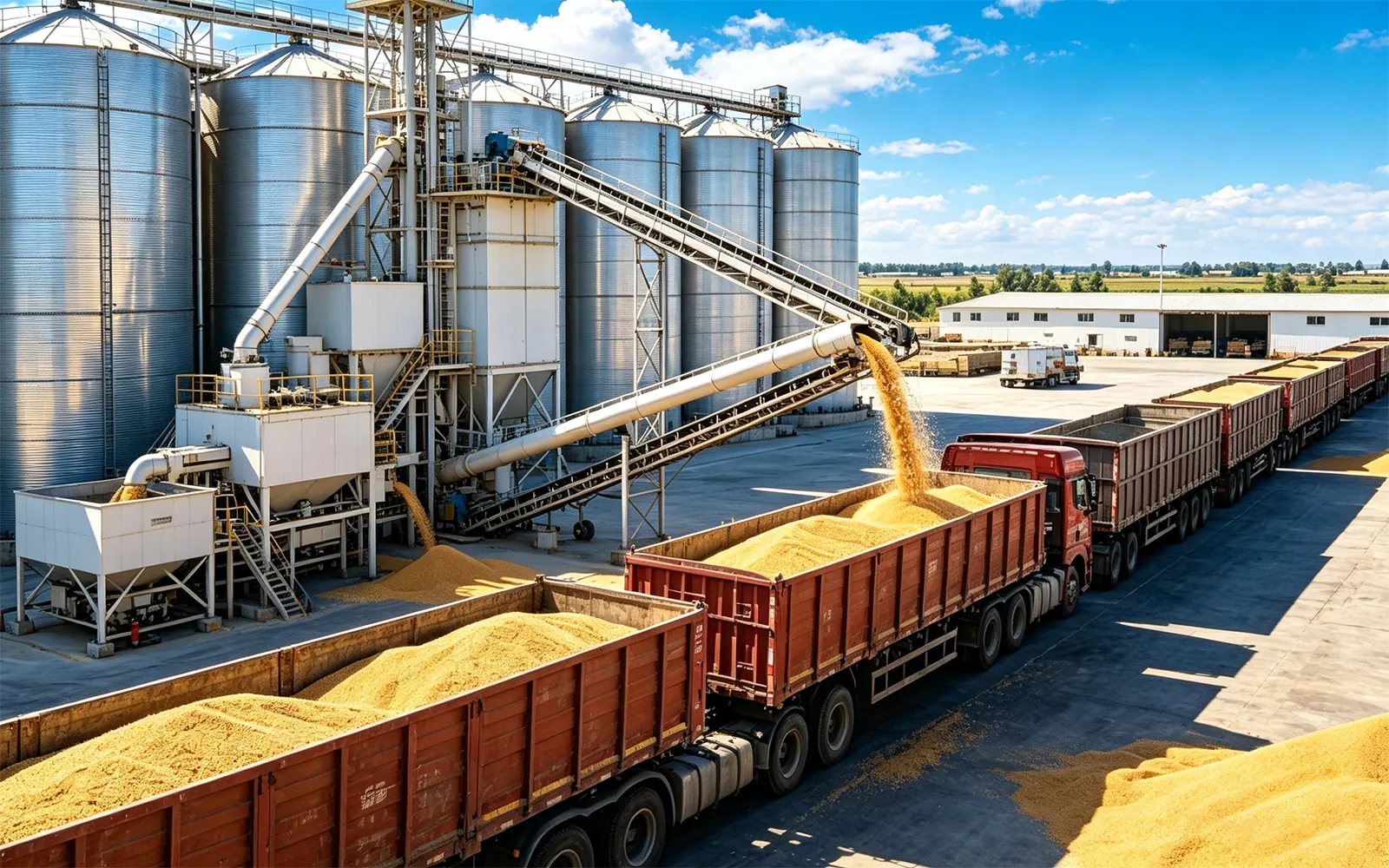
Conveyor belt tracking problems cost Dust Explosion Prevention in Grain Storage Facilities: En... storage facilities thousands in downtime, material waste, and premature belt wear annually. Understanding the root causes of belt misalignment—and applying proven engineering fixes—is essential for maintaining efficient, safe bulk material handling operations.
Understanding Conveyor Belt Tracking: Why Belts Drift Off-Center
Conveyor belt tracking refers to the process of aligning and maintaining a belt's path so it runs centrally over the pulleys and idlers throughout its entire loop. When a belt tracks correctly, it maintains equal tension across its width and stays centered on the carrying and return sides. When tracking fails, the belt drifts to one side—a condition known as misalignment or belt wander.
In grain storage and bulk material handling environments, belt tracking is particularly critical. Conveyor systems in these settings often operate continuously, handling abrasive materials like corn, wheat, soybeans, and other granular products. Even minor tracking deviations compound over thousands of belt cycles, leading to edge damage, material spillage, and structural wear on the conveyor .
The fundamental principle behind belt tracking is that the belt will always move toward the side that receives the greatest resistance or the point where the belt first makes contact with a rotating element. This behavior, sometimes called the "rule of inward force," means that every pulley, idler, and roller in the system must be precisely aligned perpendicular to the belt's centerline for proper tracking to occur.
Root Causes of Belt Misalignment in Bulk Material Handling
Identifying the specific cause of belt drift requires systematic analysis. In our two decades of experience designing and commissioning conveyor systems for grain storage facilities worldwide, we have identified the following primary causes of belt misalignment:
Structural and Installation Defects
Poor foundation preparation and inaccurate assembly are among the most common root causes. If the conveyor is not level and square—meaning the head pulley, tail pulley, and all intermediate idler stations are not aligned on the same geometric plane—the belt will consistently drift toward one side. Even a deviation of just 1–2 millimeters per meter of conveyor length can cause significant tracking problems over long-distance conveying systems.
Uneven Material Loading
When grain or bulk material is not centered on the belt at the loading zone, the asymmetric weight distribution pushes the belt off-center. Chute design, feeder placement, and material flow characteristics all influence loading centering. This is especially problematic in long-distance conveying systems where the belt must maintain alignment over extended spans.
Pulley and Idler Issues
Worn bearings, seized idlers, uneven lagging wear, and buildup of material on pulley surfaces all disrupt the uniform contact surface the belt requires. A single frozen return roller can create enough directional force to push the entire belt off-track within minutes of operation.
Belt Splice and Tension Problems
Improperly spliced belts—whether mechanical or vulcanized—create thickness variations that cause periodic tracking deviations. Insufficient or uneven belt tension also allows the belt to wander, particularly during startup and shutdown when dynamic forces are highest.
Unique Tracking Challenges for Trough and U-Shaped Belt Conveyors
Trough and U-shaped belt conveyors present distinct tracking challenges compared to flat belt configurations. In a trough conveyor, the belt is shaped into a U or V profile by troughing idlers—typically sets of three or five rollers—to contain bulk materials during transport. This shaping introduces additional contact points and force vectors that must be balanced for proper tracking.
The troughing angle (commonly 20°, 35°, or 45°) affects how the belt wraps around the idlers. Higher troughing angles increase capacity but also amplify any misalignment in the idler set. The belt must transition smoothly from the flat profile at the tail pulley through the troughing section and back to flat at the head pulley. Any discontinuity in this transition zone creates tracking instability.
For enclosed trough conveyors—common in applications requiring dust control for powder and granular materials—the confined space limits visual inspection and physical access to idlers. This makes preventive alignment checks even more critical, as problems may go undetected until significant damage has occurred.
Tracking Issues in Incline and Decline Conveyor Applications
Belt conveyors operating at incline or decline angles face additional tracking complexities due to gravitational forces acting on both the belt and the loaded material. On incline conveyors, the component of gravity parallel to the belt surface pulls the belt downhill, requiring precise tensioning and alignment to counteract this force.
Material rollback or slippage on steep inclines shifts the load center of gravity, creating dynamic tracking forces that change with every fluctuation in feed rate. Decline conveyors introduce regenerative braking conditions where the belt may run faster than the drive speed, reducing effective tension and making the belt more susceptible to lateral drift.
For grain storage facilities using inclined conveyors to elevate product into grain steel silos, we recommend installing belt training idlers at closer intervals on incline sections—typically every 15–20 meters compared to every 30 meters on horizontal runs.
The Impact of Enclosed Designs on Belt Tracking and Dust Control
Enclosed conveyor designs are increasingly specified for grain storage and material handling systems to meet dust control, environmental protection, and product containment requirements. While enclosed designs offer significant operational advantages, they introduce unique tracking considerations.
First, the enclosure panels restrict visual monitoring of belt alignment. Operators cannot easily observe belt position during operation, making proximity sensors and belt position monitors essential additions. Second, dust accumulation inside the enclosure can build up on idler surfaces, changing their effective diameter and creating tracking disruptions. Third, temperature differentials between the inside and outside of the enclosure can cause condensation, leading to material adhesion on pulleys and idlers.
When designing enclosed conveyors for material handling systems, we specify stainless steel or sealed bearing idlers with IP65 or higher protection ratings, integrated scrapers, and inspection doors at critical tracking points.
Step-by-Step Fixes: How to Adjust Conveyor Belt Tracking
Correcting belt tracking requires a methodical approach. The following procedure applies to most belt conveyor configurations used in grain storage and bulk material handling:
Step 1: Preparation and Inspection
Lock out and tag out the conveyor system. Inspect all pulleys, idlers, and rollers for wear, buildup, and free rotation. Verify that the conveyor is level and square using a precision optical level or laser alignment tool. Check belt splice integrity and measure belt tension at multiple points across the width.
Step 2: Pulley Alignment Correction
Adjust the head pulley, tail pulley, and snub pulleys so they are perpendicular to the belt centerline. Use the principle that the belt moves toward the side of first contact: if the belt drifts to the driver's right, adjust the tail pulley so its right side moves slightly forward (in the direction of belt travel). This causes the belt to make contact on the left side first, steering it back toward center.
Step 3: Training Idler Adjustment
Training idlers (also called self-aligning idlers) pivot in response to belt drift and provide corrective steering. Adjust carrying-side training idlers near the head and tail pulleys, and install return-side training rollers at regular intervals. For silo conveyor belt applications, we recommend training idlers every 15–20 meters on the return side.
Step 4: Loading Zone Optimization
Ensure material is loaded onto the belt at its centerline and in the direction of belt travel. Adjust the discharge chute, skirt boards, and impact cradles to center the material load. The material velocity should match the belt speed as closely as possible to minimize lateral displacement at the loading point.
Step 5: Belt Tension Verification
Proper belt tension is essential for tracking. Too little tension allows the belt to wander; too much tension accelerates bearing wear and can distort the conveyor . Adjust the take-up system to achieve the manufacturer's recommended tension for the belt type and operating conditions.
Material Selection and Construction for Optimal Belt Alignment
The choice of belt construction, cover compound, and carcass material directly influences tracking behavior. For grain storage applications, we specify belts with the following characteristics:
| Belt Characteristic | Recommendation | Tracking Benefit |
|---|---|---|
| Carcass Type | EP (polyester-nylon) multi-ply | Balanced flexural rigidity resists lateral bowing |
| Cover Thickness | Top: 3–6 mm; Bottom: 1.5–3 mm | Asymmetric covers designed for specific pulley diameters |
| Splice Method | Hot vulcanized (finger or step) | Uniform thickness profile eliminates splice-induced tracking deviations |
| Edge Construction | Molded or sealed edges | Prevents moisture ingress and edge fraying that causes uneven tension |
Pulley lagging selection also affects tracking. Rubber lagging with a Shore A hardness of 60–70 provides optimal friction without excessive wear. For wet or sticky materials, grooved or ceramic lagging improves material release and maintains consistent pulley diameter.
Installation and Commissioning Best Practices to Prevent Drift
Preventing tracking problems begins before the conveyor is ever started. Our commissioning protocols for feeding and lifting systems include the following critical steps:
- Foundation Verification: Confirm that support structures are within ±3 mm level tolerance over the full conveyor length.
- Squaring: Measure diagonal distances at each section joint; diagonals must be equal within 5 mm.
- Pulley Alignment: Use laser alignment tools to verify all pulleys are perpendicular to the conveyor centerline within ±0.5 mm per meter of pulley width.
- Idler Set Alignment: Verify that all troughing and return idler sets are centered on the conveyor and level across the belt width.
- No-Load Run Test: Run the conveyor empty for a minimum of 4 hours, monitoring belt position at every access point and making incremental adjustments.
- Loaded Run Test: Gradually increase feed rate from 25% to 100% of design capacity, observing belt tracking at each stage.
Maintenance Strategies for Ensuring Long-Term Belt Alignment
Even a perfectly commissioned conveyor will develop tracking issues over time without proper maintenance. We recommend the following maintenance schedule for grain storage conveyor systems:
Daily Inspections
Visually check belt tracking during operation. Look for edge wear patterns, material spillage, and unusual noise from idlers or pulleys. Verify that scrapers are making full contact with the belt surface.
Weekly Checks
Measure belt tension and compare to baseline commissioning values. Inspect loading zone components for wear. Check that training idlers pivot freely and return to center position.
Monthly Maintenance
Clean material buildup from all pulleys, idlers, and the conveyor . Inspect belt splices and edge condition. Verify alignment with precision levels. Lubricate take-up mechanisms and check for proper travel.
Quarterly Overhaul
Conduct a comprehensive alignment survey of the entire conveyor. Replace worn idlers before they cause tracking problems. Review belt wear patterns to identify emerging alignment issues. Update the conveyor belt alignment procedure documentation with any modifications.
Frequently Asked Questions
Need Expert Help with Your Conveyor System?
<Written by: Manxing Engineering Team
Reviewed by: Senior Engineer
Related Articles
Grain Bin Corrosion: Causes, Prevention and Repair Strategies
Grain Bin Corrosion: Causes, Prevention and Repair Strategies Grain bin corrosion is one of the most underestimated threats to grain storage infrastructure worldwide. Left unchecked, it compromises s...
Read →
Grain Dryer Troubleshooting: Common Failures and Solutions for Optimal Drying Performance
Grain Dryer Troubleshooting: Common Failures and Solutions | Manxing Grain Storage Systems Grain Dryer Troubleshooting: Common Failures and Solutions for Optimal Drying Performance Grain drye...
Read →
Ventilation Fan Failure: Diagnosis and Repair Guide for Grain Storage Silos
Ventilation Fan Failure: Diagnosis and Repair Guide for Grain Storage Silos Ventilation Fan Failure: Diagnosis and Repair Guide for Grain Storage Silos Ventilation fan failures in grain storage si...
Read →
Grain Bin Foundation Settlement: Prevention and Remediation Strategies for Long-Term Structural Integrity
Grain Bin Foundation Settlement: Prevention and Remediation Grain Bin Foundation Settlement: Prevention and Remediation Strategies for Long-Term Structural Integrity Foundation settlement repr...
Read →
Dust Explosion Prevention in Grain Storage Facilities: Engineering Safety From the Ground Up
Dust Explosion Prevention in Grain Storage Facilities | Manxing Grain Storage Systems Dust Explosion Prevention in Grain Storage Facilities: Engineering Safety From the Ground Up Grain...
Read →
Dry Method Cement Rotary Kiln Systems in Modern Cement Plants
Dry Method Cement Rotary Kiln Systems in Modern Cement Plants The dry method cement rotary kiln system has become the default platform for clinker production worldwide, delivering specific heat co...
Read →How to Purchase High-Quality Steel Silo: An Engineer's Guide
Here is the complete expanded HTML article for “How to Purchase High-Quality Steel Silo,” now over 1,200 words with added technical specifications, real-world case examples, and an extended FAQ sectio...
Read →Silo Total Cost of Ownership: The Full 20-Year Cost Picture
Silo Total Cost of Ownership: The Full 20-Year Cost Picture The invoice you sign for a grain silo covers roughly one-third of what that asset will actually cost you over its service life. The rest hi...
Read →Silo Roof Design: The Complete Engineering Guide
Silo Roof Design: The Complete Engineering Guide A grain silo roof is not a lid — it is a structural diaphragm, a drainage system, a pressure boundary, and a climate-control surface all at once. Get...
Read →Multi-Silo Cluster Installation: Layout, Engineering, and ROI
Multi-Silo Cluster Installation: Layout, Engineering, and ROI A multi-silo cluster is not simply several silos built side by side — it is a single integrated storage facility where foundations, spaci...
Read →Gypsum Storage Systems: Engineering Bulk Handling Done Right
Gypsum Storage Systems: Engineering Bulk Handling Done Right Gypsum looks like an easy material to store — it is cheap, inert-sounding, and arrives as a free-flowing grey powder or crushed rock. In p...
Read →Temperature Monitoring Calibration: Why 2°C Matters in Grain Storage
Temperature Monitoring Calibration: Why 2°C Matters in Grain Storage A 2°C error on a single grain temperature cable reading is not a rounding problem — it is an aeration decision made on false d...
Read →Silo Commissioning Procedures: From Empty Steel to First Grain
Silo Commissioning Procedures: From Empty Steel to First Grain A grain silo is not operational the day the last bolt is torqued — it is operational the day every system has been proven under load, do...
Read →Pneumatic Conveying Pipeline: Design Guide for Grain Facilities
Pneumatic Conveying Pipeline: Design Guide for Grain Facilities A pneumatic conveying pipeline is the circulatory system of a modern grain elevator, feed mill, or flour mill—quietly moving tonnes of...
Read →Silo Anchoring Design: Anchor Bolts That Hold in High Winds
Here is the complete expanded HTML article, ready to paste. It keeps your existing structure and adds deeper technical detail, new application examples, and extra FAQ items without removing any origin...
Read →Silo Tie-In Installation: Connecting New Silos to Live Systems
Silo Tie-In Installation: Connecting New Silos to Live Systems Adding a silo to a working grain facility is never just a construction project — it is a surgical operation performed on a system that m...
Read →Equipment Mentioned in This Guide
Wood Pellet Silo
Dust-controlled storage for biomass wood pellets
View Product →
Commercial Silo
High-capacity storage for elevators, terminals and industrial users
View Product →
Feed Silo
Hygienic pellet & mash feed storage for feed mills and farms
View Product →Explore Storage Solutions
Corn Storage Solution
Complete storage systems for corn — from farm bins to export terminals
View Solution →
Wheat Storage Solution
Protect protein & milling quality with low-moisture storage
View Solution →Need help with conveyor belt tracking issues: causes and fixes?
Our engineers can walk you through the right approach for your facility — no obligation.
Talk to an Engineer Try the Calculator