A Dust Explosion Prevention in Grain Storage Facilities: En... silo roof is not a lid — it is a structural diaphragm, a drainage system, a pressure boundary, and a climate-control surface all at once. Get the geometry, loads, and detailing right, and your silo will protect Grain Bin Foundation Settlement: Prevention and Remediati... for thirty years or more. Get them wrong, and you will be chasing leaks, corrosion, and spoiled grain within a single storage season.

Silo Roof Design 101: How Geometry, Loads, and Grain Protection Work Together
Every silo roof sits at the intersection of four engineering disciplines: structural analysis, fluid mechanics (water and air), materials science, and corrosion control. A roof designer who optimizes only for structural capacity will deliver a stiff, strong roof that ponds water, traps humid air, and rusts through at the eaves in eight years.
The roof performs three core functions on a Dust Explosion Prevention in Grain Storage Facilities: En... storage structure:
Three Core Roof Functions
1. Environmental enclosure. The roof must shed precipitation, resist wind-driven rain at laps and penetrations, and prevent snow meltwater from entering the headspace. Water ingress of even a few liters per storm event can raise the equilibrium moisture content of the top grain layer enough to trigger mold growth.
2. Structural load path. Roof panels transfer snow, wind, and maintenance live loads into purlins, rafters, and finally into the silo shell or columns. On a corrugated steel silo, the roof also acts as a diaphragm that stiffens the top ring of the shell against ovalling under wind and seismic action.
3. Pressure and thermal boundary. Aeration fans push or pull hundreds of cubic meters of air per minute through the grain mass. That airflow pressurizes or depressurizes the headspace, and the roof is the surface that must absorb those pressure changes without fatiguing fasteners or lifting panels.
Why Roof Design Cannot Be Decoupled From the Silo
Roof geometry is dictated by shell diameter. A 6-meter diameter silo tolerates a simple self-supporting cone with a modest slope and light purlins. A 30-meter diameter silo cannot — the span forces you into a radial rafter and ring-beam system, a stiffened dome, or a structural flat roof on columns. Thermal cycling between the roof (which can reach 70 °C in direct sun) and the grain mass (typically 15–25 °C) also drives condensation, which is discussed in detail later in this guide.
Cone, Dome, Flat, and Hopper Roofs: Choosing the Right Silo Roof Type
Roof type selection is the single highest-leverage decision in the design process. It sets drainage performance, structural cost, usable headspace volume, and the difficulty of future maintenance.
Conical Roofs
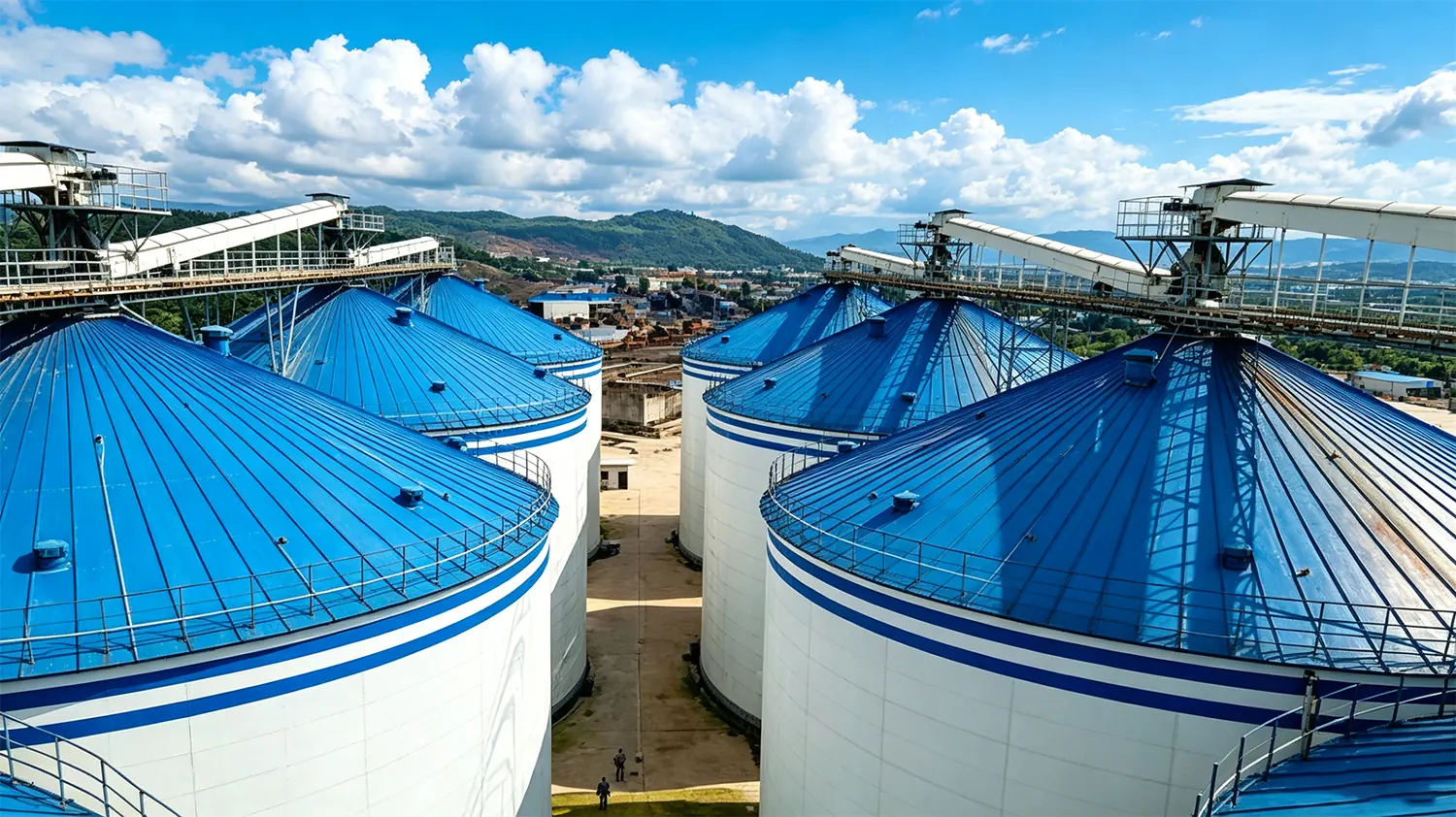
The workhorse of agricultural grain storage. Conical roofs typically use a slope between 15° and 30°, with 20°–25° being the practical sweet spot for corrugated steel silos. Steeper slopes shed snow and water faster and reduce the risk of standing water at panel laps, but they consume more material and increase the wind-exposed surface area. Conical roofs are self-supporting up to roughly 12–15 m diameter; beyond that, they require internal columns or a ring-beam and rafter system.
Dome (Spherical / Torispherical) Roofs
Domes distribute load through membrane action rather than bending, making them materially efficient for large-diameter silos. A well-designed dome on a 25 m silo can carry the same snow load as a conical roof with 20–30% less steel. The trade-offs are higher fabrication complexity, more panel curvature (which means more seams and more sealant), and a less intuitive drainage pattern that requires careful attention to the apex and the eaves.
Flat and Low-Slope Roofs
Flat roofs are common on rectangular or square grain storage buildings, flat-bottom hopper silos, and silos where roof-mounted equipment such as conveyors, dust collectors, or catwalks must be supported. Minimum slope for a flat roof should be 1:48 (about 1.2°) for membrane systems and no less than 1:24 (about 2.4°) for metal panel systems. Anything flatter is a ponding risk, and ponding loads are self-reinforcing — the more water pools, the more the roof deflects, the more water pools.
Hopper Roofs and Inverted Configurations
Inverted hopper roofs (funnel-shaped, sloping inward) are used where the roof must feed material into a central inlet or where the roof supports a dust collection system. They are structurally efficient in compression but drainage-hostile and should only be specified with a fully welded or continuously sealed membrane and a generous slope.
Roof Type Comparison
| Roof Type | Typical Slope | Practical Diameter Range | Best Application | Key Watch-Out |
|---|---|---|---|---|
| Conical | 15°–30° | 3–15 m self-supporting | Farm and commercial grain silos | Eave and lap corrosion |
| Dome | Variable (membrane) | 15–40 m | Large flat-bottom terminals | Complex sealing at seams |
| Flat / low-slope | 1.2°–5° | Any (on columns/beams) | Rectangular stores, equipment decks | Ponding and membrane fatigue |
| Inverted hopper | 30°–45° inward | 3–12 m | Central inlet, dust collection | Drainage and debris accumulation |
Roof Loads Decoded: Snow Drift, Wind Uplift, and Seismic Forces on Grain Silo Roofs
Roof structural design must account for load combinations, not individual loads. A roof that is adequate for a 1.5 kPa snow load in isolation may fail when that snow load is combined with wind uplift reversal on the leeward side and internal pressure from an aeration fan.
Dead and Live Loads
Dead load includes panels, purlins, rafters, insulation, vents, catwalks, and permanently mounted equipment. Live load covers maintenance access — typically 1.0 kPa (about 20 psf) on accessible areas, though many operators neglect to specify this and later discover that a roof designed for zero live load cannot safely support an inspection team.
Snow Loads and Unbalanced Drift
Uniform snow load is straightforward. Unbalanced snow load is where roofs fail. Wind scours snow from the windward side of a conical roof and deposits it on the leeward side and against any obstruction — a vent stack, a catwalk, a taller adjacent silo. Drift loads can reach two to three times the ground snow load in the drift zone. Designers must apply drift surcharges to the leeward quadrant and around every roof penetration.
Wind Uplift
Wind flowing over a roof creates negative pressure (suction) on the surface. For low-slope roofs, edge and corner zones experience uplift coefficients several times higher than the field of the roof. On a silo, the situation is compounded because the headspace is typically vented — if vents are undersized or blocked, internal pressure adds to the net uplift. Fastener pull-out and panel flutter at the eaves are the classic failure signatures.
Seismic Forces
Seismic design for silo roofs focuses on two things: the roof's own inertial mass, and the roof's role in maintaining shell roundness. A roof diaphragm that slips relative to the shell can allow the top ring to oval, which then buckles the shell wall. Slotted connections, oversized holes, and flexible fasteners used for erection tolerance can all become seismic weak links if not detailed with positive load transfer in mind.
Roof Slope and Drainage: Why Water Management Determines Silo Roof Lifespan
Water is the most persistent enemy of any silo roof. Standing water at a panel lap wicks under capillary action and reaches the fastener, where it sits against a cut edge of galvanized steel — the single most corrosion-prone location on the entire structure.
Minimum Slope Rules of Thumb
For standing seam metal roofing, a minimum slope of 1:12 (about 4.8°) is generally accepted, though 1:6 (about 9.5°) is far more forgiving. For through-fastened corrugated panels, do not go below 1:4 (about 14°). For conical silo roofs, 20° is the practical minimum for reliable gravity drainage; below that, thermal movement of panels combined with panel deflection creates local low points that trap water.
Gutters, Downspouts, and Eave Detailing
Gutter sizing must be based on the design rainfall intensity for the site, not a standard catalogue size. A 12 m diameter silo roof has a plan area of about 113 m², and in a 100 mm/hour rainfall event that roof collects roughly 11,300 liters per hour — 3.1 liters per second. Gutters and downspouts sized for average rainfall will overflow at the eaves during every convective storm, driving water directly into the shell panel laps.
Critical detailing points:
- Continuous drip edge at the eave to break water adhesion and prevent backflow under the panel.
- Downspouts sized at a minimum of one 90 mm outlet per 40 m² of roof plan area.
- Gutter hangers spaced no more than 600 mm on center to prevent sagging and ponding.
- Overflow scuppers so that a blocked downspout does not turn the gutter into a pond.
Ventilation, Pressure Relief, and Aeration: Designing a Silo Roof That Breathes
Aeration is where roof design most often goes wrong. When a fan pushes air into a full silo, the headspace must exhaust an equivalent volume or the roof becomes a pressure vessel.
Pressure Relief Valve Sizing
Pressure and vacuum relief valves must be sized to pass the full fan output at a pressure differential low enough to protect the roof panels. A common failure mode is a relief valve sized for the average fan rather than the peak fan, or a valve installed with a blocked or undersized duct. As a rule, relief capacity should be validated against the largest single fan in the aeration system, plus a margin, and the valve should be positioned so that it is not shielded by internal structures.
Passive Roof Ventilation
Ridge vents and eave vents allow the headspace to breathe under natural convection. A useful planning figure is roughly 0.1 m² of net free vent area per 1,000 m³/hour of aeration airflow for passive venting, but this must always be confirmed by the relief valve sizing calculation. Net free area — not nominal opening area — is the number that matters; louvers, bird screens, and insect mesh can reduce free area by 40% or more.
Headspace Ventilation Strategy
For high-value or high-moisture-risk storage, a dedicated headspace ventilation system that continuously exchanges the air above the grain surface prevents the accumulation of warm, humid air driven off the top grain layer. This is especially important after a drying cycle, when the grain surface can be 10 °C warmer than the ambient air.
Condensation and Headspace Microclimate: The Hidden Roof Design Factor Behind Grain Spoilage
Condensation is invisible in the design phase and brutally visible in the storage phase. It occurs when the underside of the roof panel drops below the dew point of the headspace air.
Why Condensation Happens on Silo Roofs
On a clear