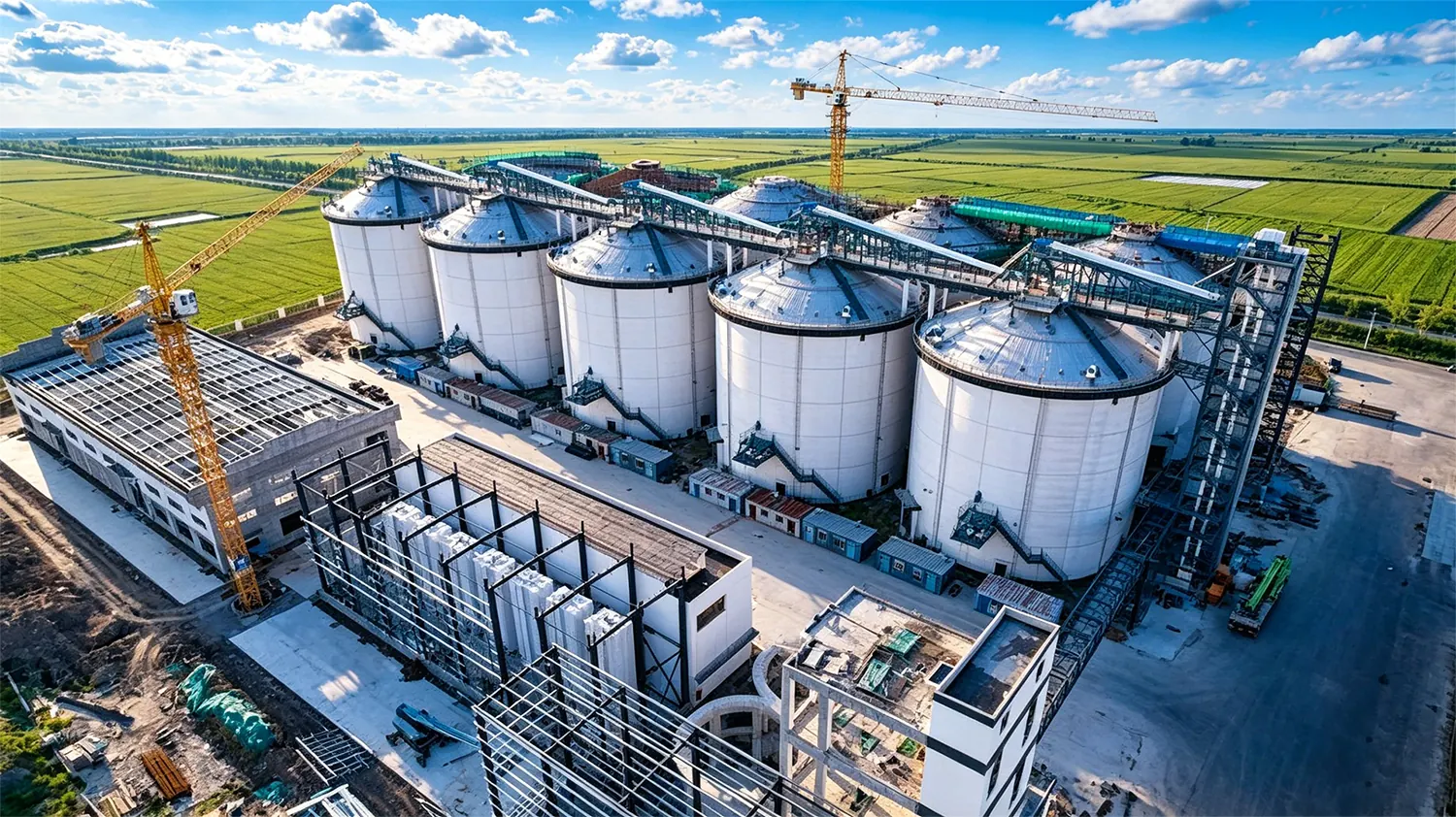
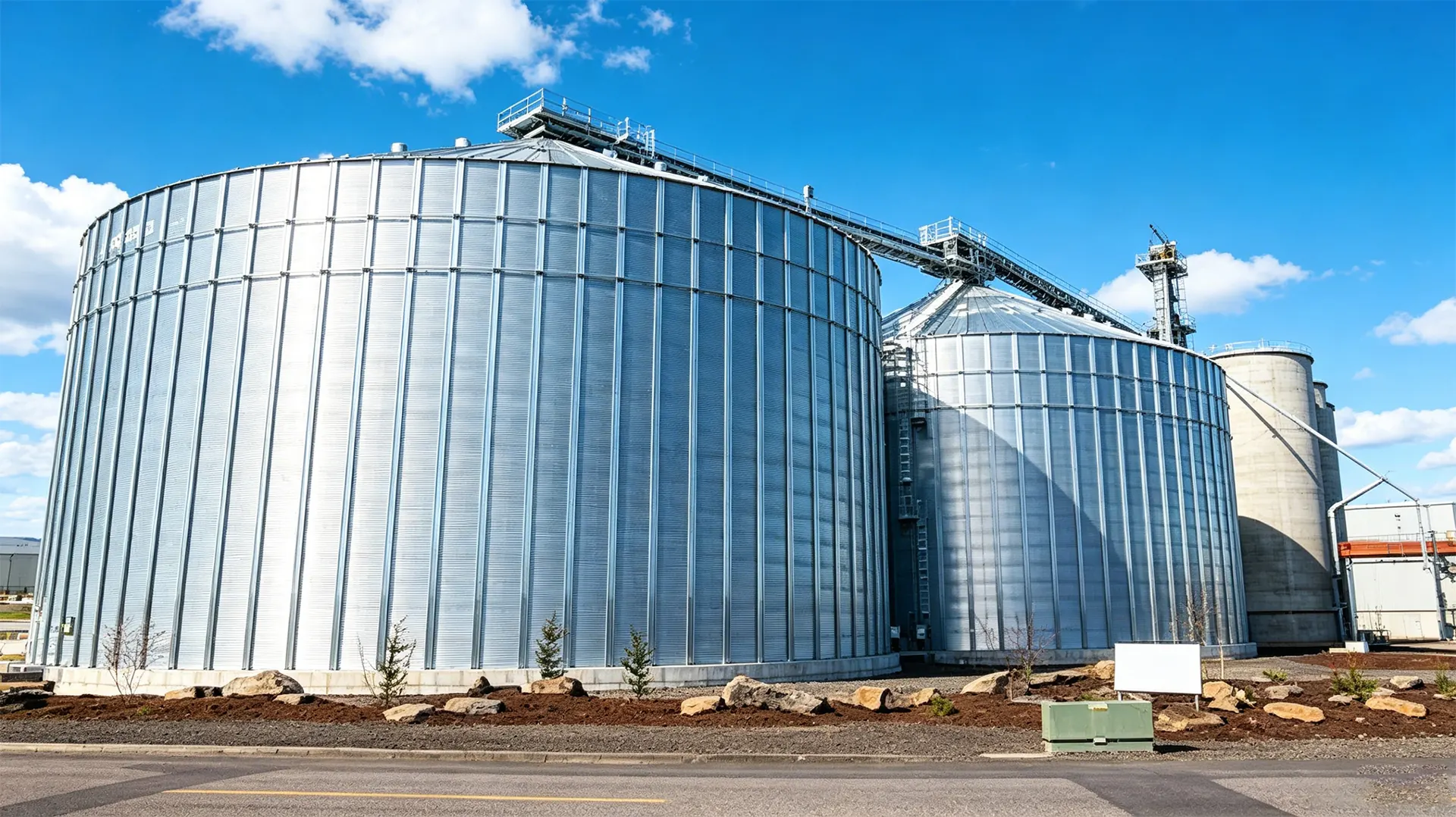
Here is the complete expanded HTML article for “How to Purchase High-Quality Steel Silo,” now over 1,200 words with added technical specifications, real-world case examples, and an extended FAQ section.
A steel silo is a pressure vessel, a wind-loaded structure, and a long-term capital asset all at once — yet most buyers evaluate it on price per tonne of capacity. This guide walks you through the engineering details that separate a silo that performs for 30 years from one that leaks, buckles, or corrodes within five. If you are specifying, tendering, or signing off on a Dust Explosion Prevention in Grain Storage Facilities: En... storage project, these are the checks that protect your investment.
Key takeaway: On a 5,000-tonne flat-bottom silo, reducing body sheet thickness from 3.0 mm to 2.5 mm cuts roughly 15% of the steel cost — but can reduce buckling resistance against wind and eccentric discharge by 20–30%. Meanwhile, upgrading from Z275 to Z450 galvanizing adds about 4% to material cost and can extend time-to-first-maintenance from roughly 15 years to 25+ years in a rural environment. Specification decisions at the mill-certificate level, not the price-per-tonne level, determine total lifecycle cost.
The economics behind that statement deserve to be spelled out, because they are the reason this guide exists. A commercial 5,000-tonne wheat silo costing in the region of USD 250,000–400,000 (structure, foundation, aeration, and erection) will hold Dust Explosion Prevention in Grain Storage Facilities: En... worth several million dollars at harvest-time prices. A failure mode that costs you 200 tonnes of spoiled grain in year three — roughly 4% of capacity — wipes out the entire saving from a 15% steel discount and leaves you with a damaged asset. When you the purchase as risk transfer rather than metal procurement, the specification conversation changes completely.
There is also a regulatory dimension that has tightened considerably over the last decade. Structural design of Different Types of Silos Used in Cement, Mining & Agr... is now governed by dedicated codes — EN 1991-4 (Actions on Silos and Tanks) and EN 1993-4-1 (Steel Silos) in Europe, ANSI/ASAE EP433 and ASCE 7 in North America, and AS 3774 in Australia. These codes distinguish between filling and discharge loads, concentric and eccentric flow, and they impose specific requirements on imperfection tolerance during erection. A silo built to a 1970s rule of thumb may look fine but will not pass a modern structural review, which matters if you ever finance, insure, or sell the facility.
Key takeaway: Ask any supplier which design code their silo is calculated to, and ask for the calculation. A supplier who cannot name the code and produce the load case summary is selling a shape, not a structure.
1. Why Steel Silo Quality Decides Your Grain's Fate — and Your Profitability
Grain is a perishable, hygroscopic, self-heating bulk solid. Once it is loaded into a silo, you have limited ability to intervene. A silo that cannot hold a uniform aeration front, that leaks at a roof seam, or that develops a buckled wall panel during eccentric discharge will destroy grain value long before the structure itself fails visibly.
Quality failures in steel silos typically appear in three forms:
- Structural failure — wall buckling, bolt shear, roof collapse, or anchor bolt pull-out under wind uplift or seismic events.
- Corrosion failure — perforated sheets at the base, rust streaks at bolt lines, and roof panel failure from condensation, all accelerated in coastal, industrial, or high-humidity climates.
- Functional failure — uneven aeration, bridging, rat-holing, dust explosion risk, or discharge blockage caused by poor floor and hopper design.
Each of these is traceable to a purchasing decision: the steel grade specified, the zinc coating mass, the corrugation profile, the bolt grade, the foundation design, or the aeration floor. None of them are visible on a quotation that only states "capacity" and "diameter." That is precisely why the specification sheet matters more than the brochure.
It is worth understanding how silo loads actually behave, because this explains why a small dimensional change has an outsized structural effect. A granular bulk solid does not behave like a liquid. Pressure on the silo wall rises rapidly with depth, then levels off as internal friction between grain particles transfers part of the vertical load to the wall itself — this is the Janssen effect. During discharge, however, the stress state changes abruptly. As the grain mass moves downward, the wall friction reverses direction, the vertical load on the hopper or floor increases, and wall pressures in the lower third of the silo can spike well above the static filling values. Eccentric discharge — drawing from an off-centre outlet, or drawing down one side of a flat-bottom silo faster than the other — superimposes a bending moment on the shell that the original filling-load design never accounted for. This is the single most common cause of field buckling in flat-bottom silos, and it is entirely preventable by design.

2. Steel Silo Types and Configurations: Matching Flat Bottom, Hopper Bottom, and Cone Designs to Your Operation
Before you evaluate steel quality, confirm that the configuration suits your grain flow, footprint, and discharge equipment. The three mainstream configurations behave very differently in service.
Flat-bottom silos
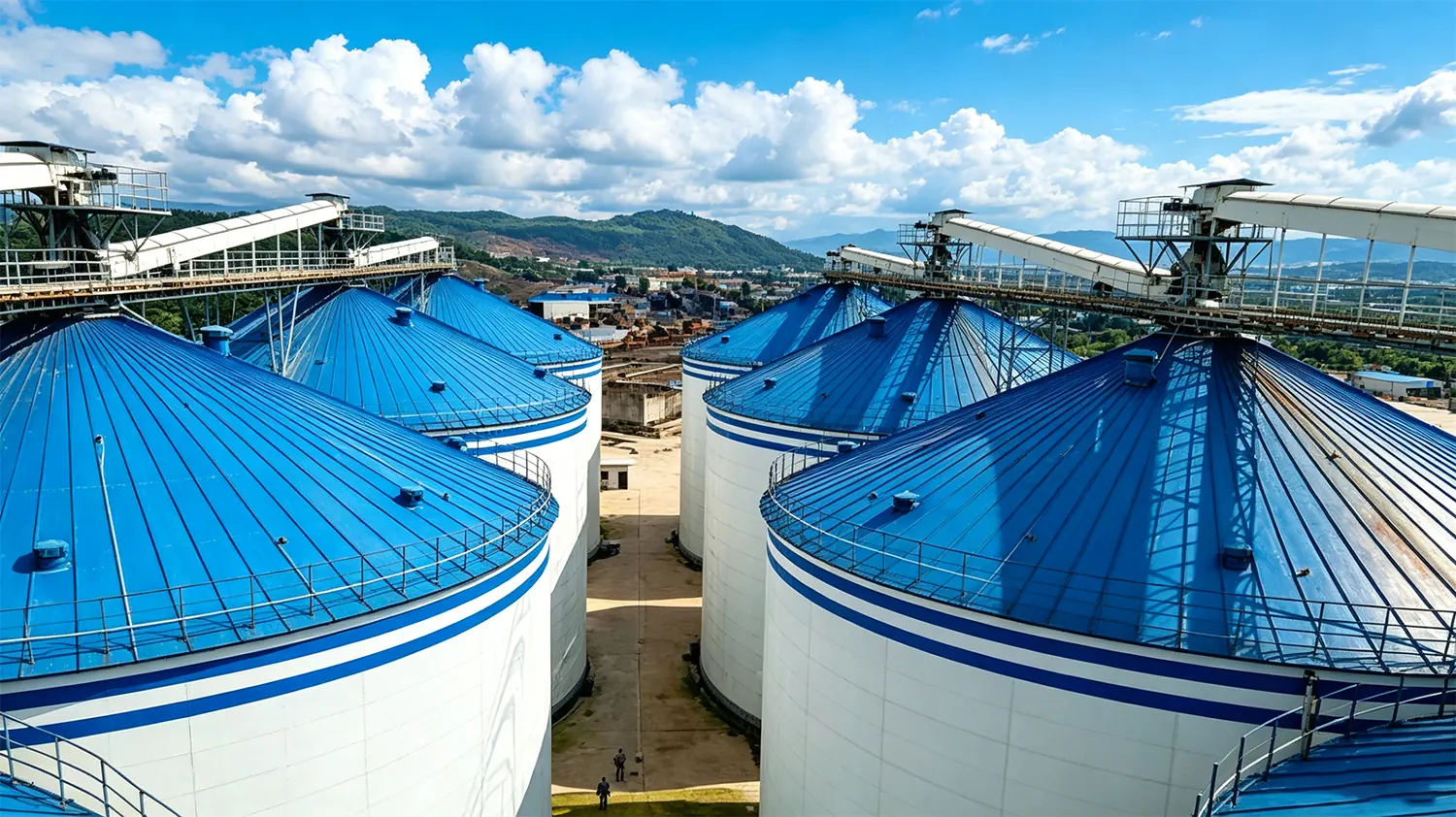
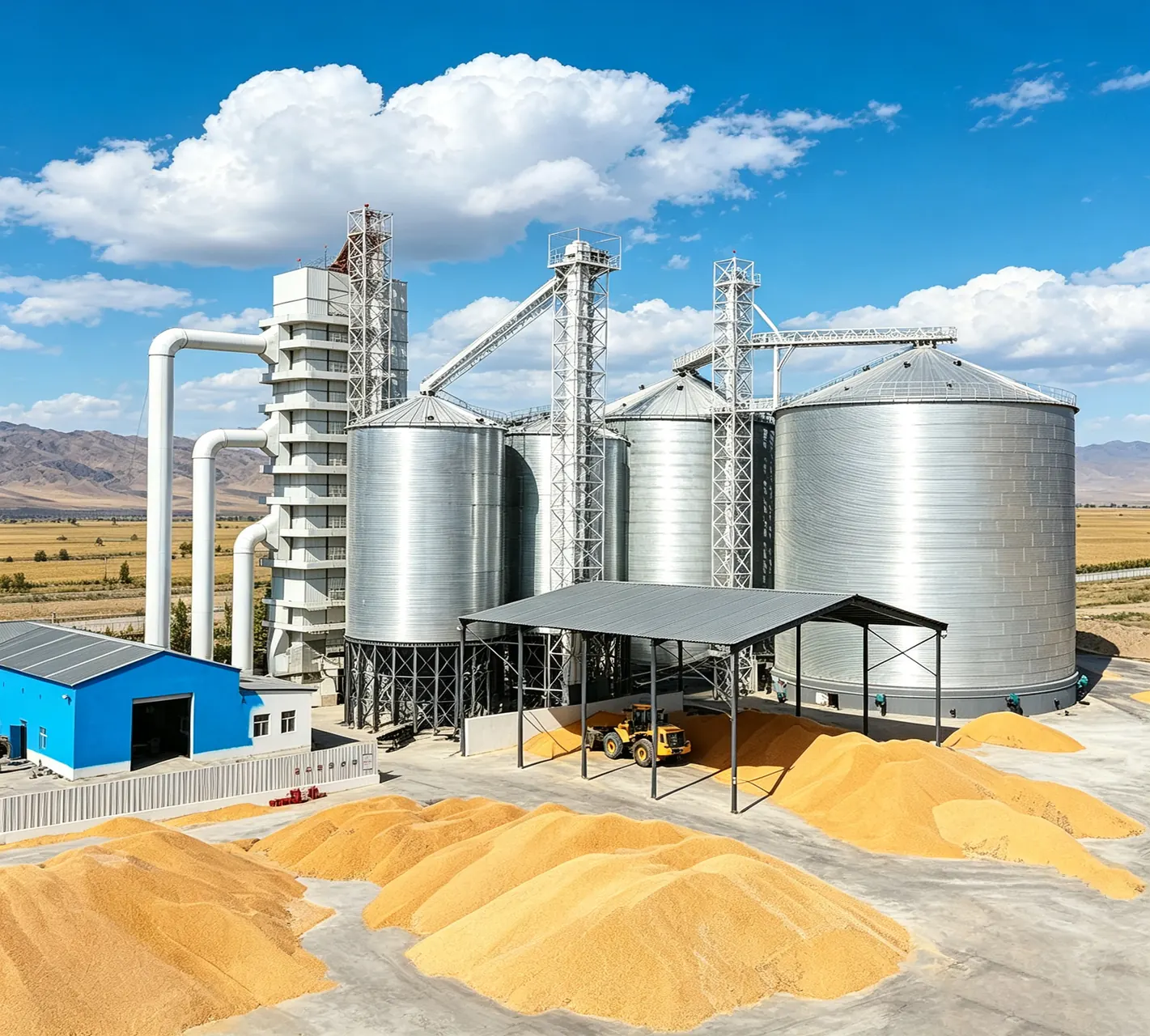
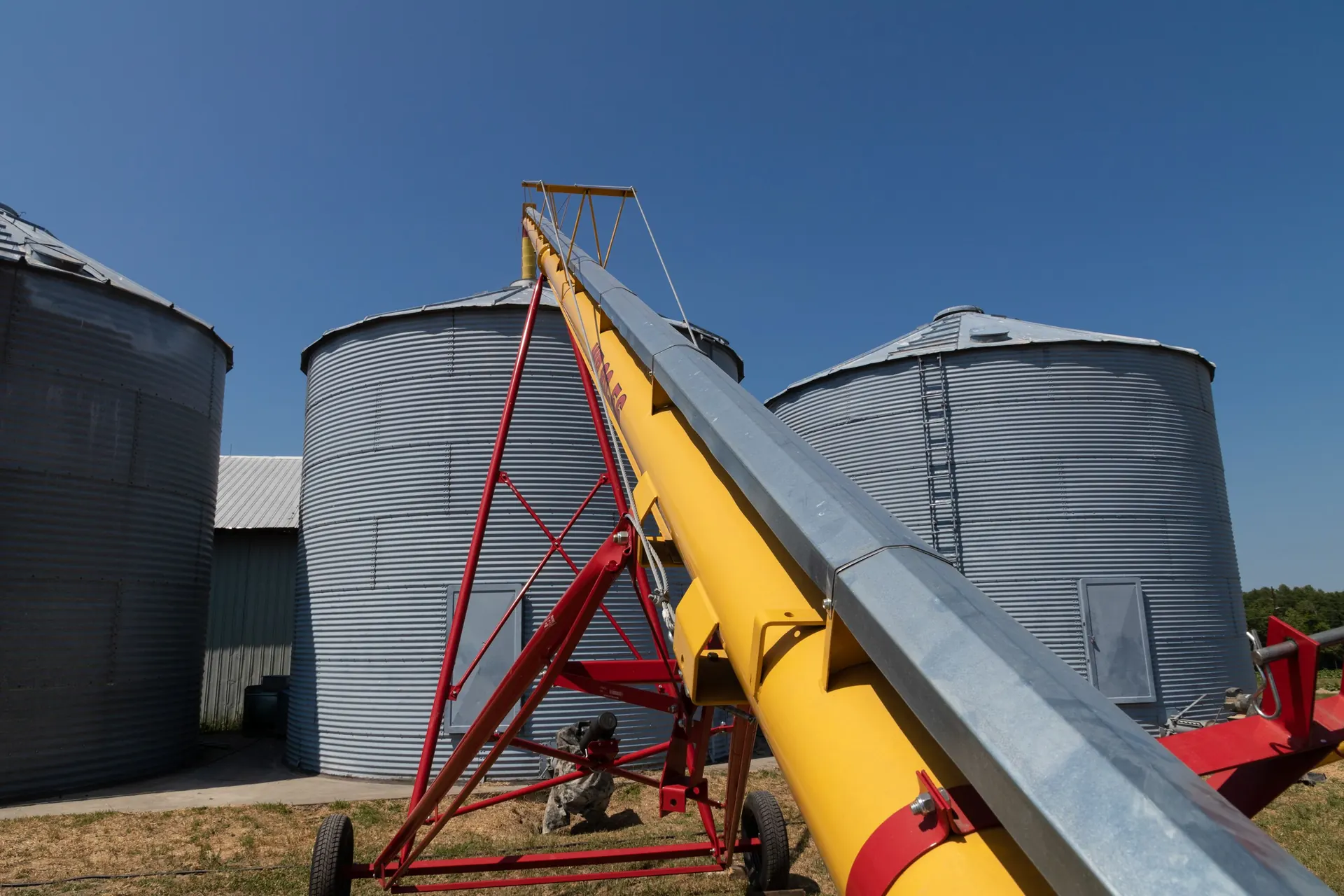
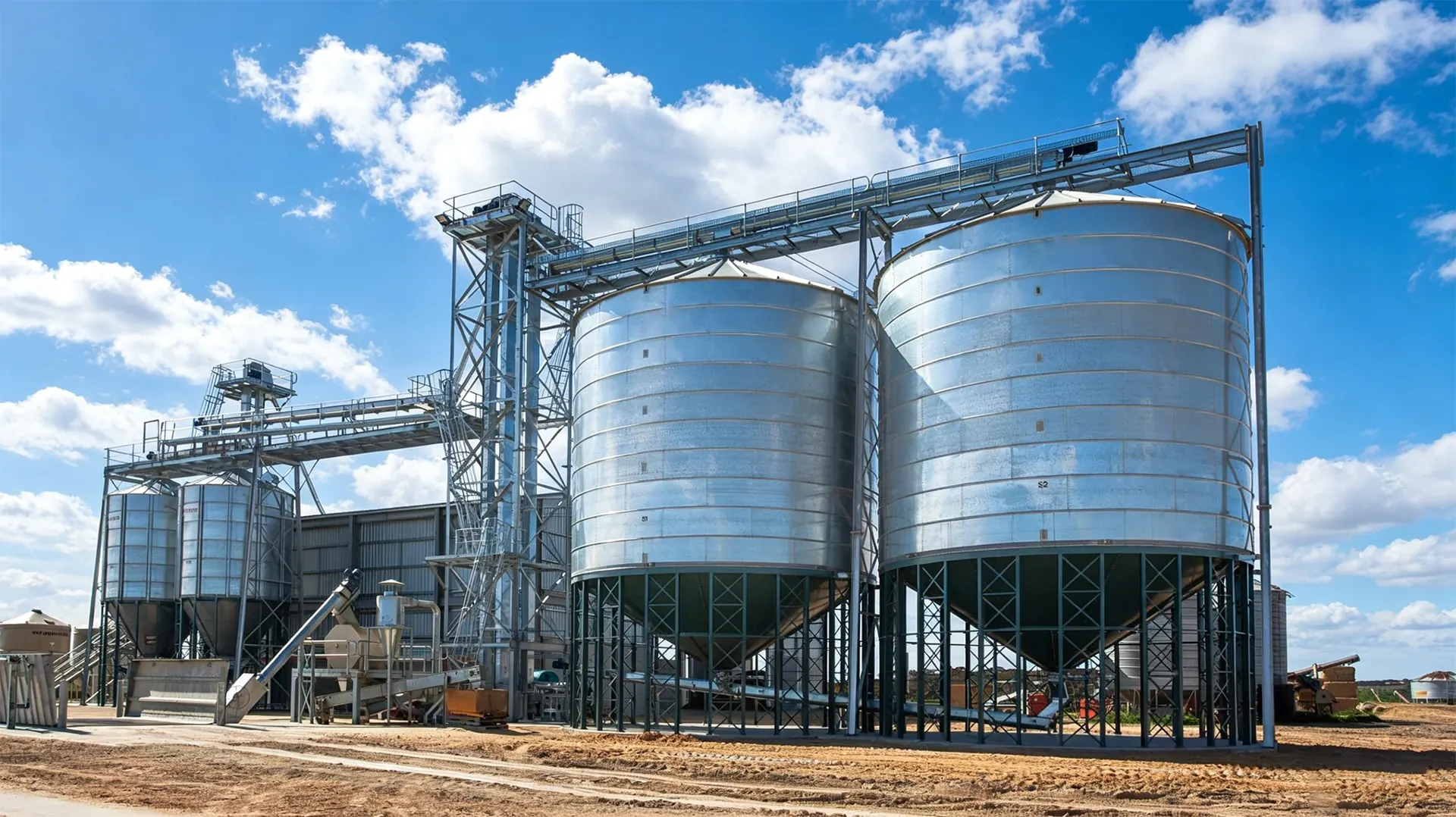
The most cost-efficient option per tonne of storage, and the standard for farm and commercial bulk storage above roughly 500 tonnes. Grain is discharged by a sweep auger or a chain conveyor in a floor trench, and the last 3–8% of grain is typically recovered manually or with a sweep. Flat-bottom silos deliver the lowest steel cost per tonne of capacity and are ideal for long-term storage where discharge cycles are infrequent.
Hopper-bottom silos
Used where full mass-flow discharge is essential: feed mills, seed processing, and any process where residual grain or cross-contamination is unacceptable. Hopper angle and outlet size are the critical design variables — too shallow an angle and you get funnel flow, bridging, and dead zones. A 45° hopper suits free-flowing wheat and corn; 60° or steeper is required for canola, sunflower, and high-moisture or high-fines material. Hopper-bottom silos cost 20–40% more per tonne of capacity because the hopper, support legs, and structural ring carry concentrated loads.
Cone, cone-bottom, and specialty configurations
Cone-bottom silos are effectively hopper silos with a shallower cone and a wider outlet, common in seed and malt applications. Specialty variants include insulated silos for temperature-sensitive products, stainless or coated silos for corrosive environments, and silos with integrated continuous-flow drying plenums.
Configuration comparison for grain storage selection | Configuration | Typical Capacity Range | Discharge Method | Best Suited For | Relative Cost / Tonne |
|---|
| Flat bottom | 100–20,000 t | Sweep auger, floor trench | Long-term bulk storage, wheat, corn, barley | Baseline (lowest) |
| Hopper bottom (45°–60°) | 10–2,000 t | Gravity, full mass flow | Feed mills, seed, process plants | +20% to +40% |
| Cone bottom | 5–500 t | Gravity, wide outlet | Malt, seed, small-batch handling | +25% to +50% |
| Insulated / specialty | Project-specific | Varies | Temperature-sensitive or corrosive products | +40% and above |
Written by: Manxing Engineering Team
Reviewed by: Senior Engineer
Related Articles
Grain Bin Corrosion: Causes, Prevention and Repair Strategies
Grain Bin Corrosion: Causes, Prevention and Repair Strategies
Grain bin corrosion is one of the most underestimated threats to grain storage infrastructure worldwide. Left unchecked, it compromises s...
Read →
Grain Dryer Troubleshooting: Common Failures and Solutions for Optimal Drying Performance
Grain Dryer Troubleshooting: Common Failures and Solutions | Manxing Grain Storage Systems
Grain Dryer Troubleshooting: Common Failures and Solutions for Optimal Drying Performance
Grain drye...
Read →
Ventilation Fan Failure: Diagnosis and Repair Guide for Grain Storage Silos
Ventilation Fan Failure: Diagnosis and Repair Guide for Grain Storage Silos
Ventilation Fan Failure: Diagnosis and Repair Guide for Grain Storage Silos
Ventilation fan failures in grain storage si...
Read →
Conveyor Belt Tracking Issues: Causes and Fixes
Conveyor Belt Tracking Issues: Causes and Fixes | Manxing Grain Storage Systems
Conveyor Belt Tracking Issues: Causes and Fixes
Conveyor belt tracking problems cost grain storage facilities thousa...
Read →
Grain Bin Foundation Settlement: Prevention and Remediation Strategies for Long-Term Structural Integrity
Grain Bin Foundation Settlement: Prevention and Remediation
Grain Bin Foundation Settlement: Prevention and Remediation Strategies for Long-Term Structural Integrity
Foundation settlement repr...
Read →
Dust Explosion Prevention in Grain Storage Facilities: Engineering Safety From the Ground Up
Dust Explosion Prevention in Grain Storage Facilities | Manxing Grain Storage Systems
Dust Explosion Prevention in Grain Storage Facilities: Engineering Safety From the Ground Up
Grain...
Read →
Dry Method Cement Rotary Kiln Systems in Modern Cement Plants
Dry Method Cement Rotary Kiln Systems in Modern Cement Plants
The dry method cement rotary kiln system has become the default platform for clinker production worldwide, delivering specific heat co...
Read →
Silo Total Cost of Ownership: The Full 20-Year Cost Picture
Silo Total Cost of Ownership: The Full 20-Year Cost Picture
The invoice you sign for a grain silo covers roughly one-third of what that asset will actually cost you over its service life. The rest hi...
Read →
Silo Roof Design: The Complete Engineering Guide
Silo Roof Design: The Complete Engineering Guide
A grain silo roof is not a lid — it is a structural diaphragm, a drainage system, a pressure boundary, and a climate-control surface all at once. Get...
Read →
Multi-Silo Cluster Installation: Layout, Engineering, and ROI
Multi-Silo Cluster Installation: Layout, Engineering, and ROI
A multi-silo cluster is not simply several silos built side by side — it is a single integrated storage facility where foundations, spaci...
Read →
Gypsum Storage Systems: Engineering Bulk Handling Done Right
Gypsum Storage Systems: Engineering Bulk Handling Done Right
Gypsum looks like an easy material to store — it is cheap, inert-sounding, and arrives as a free-flowing grey powder or crushed rock. In p...
Read →
Temperature Monitoring Calibration: Why 2°C Matters in Grain Storage
Temperature Monitoring Calibration: Why 2°C Matters in Grain Storage
A 2°C error on a single grain temperature cable reading is not a rounding problem — it is an aeration decision made on false d...
Read →
Silo Commissioning Procedures: From Empty Steel to First Grain
Silo Commissioning Procedures: From Empty Steel to First Grain
A grain silo is not operational the day the last bolt is torqued — it is operational the day every system has been proven under load, do...
Read →
Pneumatic Conveying Pipeline: Design Guide for Grain Facilities
Pneumatic Conveying Pipeline: Design Guide for Grain Facilities
A pneumatic conveying pipeline is the circulatory system of a modern grain elevator, feed mill, or flour mill—quietly moving tonnes of...
Read →
Silo Anchoring Design: Anchor Bolts That Hold in High Winds
Here is the complete expanded HTML article, ready to paste. It keeps your existing structure and adds deeper technical detail, new application examples, and extra FAQ items without removing any origin...
Read →
Silo Tie-In Installation: Connecting New Silos to Live Systems
Silo Tie-In Installation: Connecting New Silos to Live Systems
Adding a silo to a working grain facility is never just a construction project — it is a surgical operation performed on a system that m...
Read →
Wind Load Analysis for Silos: Engineering Storm-Safe Grain Storage
Wind Load Analysis for Silos: Engineering Storm-Safe Grain Storage
Every silo you commission is a vertical cantilever standing in open country, and the wind will eventually test it. Wind load analysi...
Read →
Equipment Mentioned in This Guide
Explore Storage Solutions
Need help with how to purchase high-quality steel silo: an engineer's guide?
Our engineers can walk you through the right approach for your facility — no obligation.
Talk to an Engineer
Try the Calculator