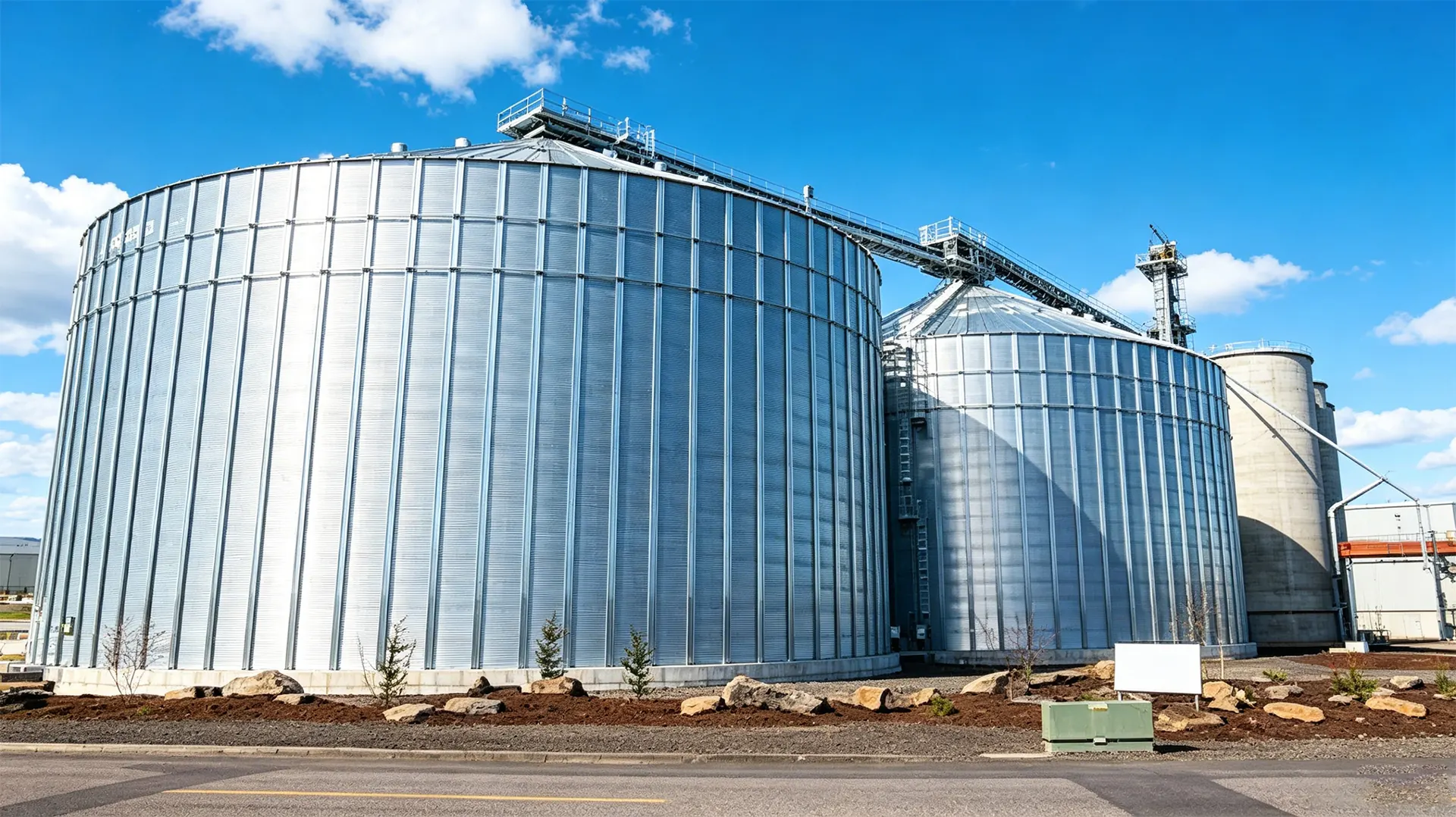
A Dust Explosion Prevention in Grain Storage Facilities: En... silo is a simple machine until it stops. Then it becomes a deadline. The difference between a two-hour repair and a two-week shutdown almost never comes down to skill — it comes down to whether the right bearing, gate seal, or shear bolt was sitting on a shelf when the discharge auger seized at 11 p.m. on the third night of harvest.
This Purchase High-Quality Steel Silo: An Engineer's Guide is written for the people who own that outcome: grain storage operators, agricultural engineers, procurement managers, and farm owners managing flat-bottom and hopper-bottom Different Types of Silos Used in Cement, Mining & Agr..., aeration systems, sweep augers, and material handling lines. We will work through risk-based parts classification, defensible min/max formulas, material-specific wear profiles, digital inventory tools, and the emergency kits that keep grain flowing when the weather will not wait.
Key takeaway: Industry benchmarking consistently shows that unplanned downtime during harvest costs far more per hour than the entire annual carrying cost of a well-built spare parts inventory. A typical rule of thumb is that carrying costs run 20–25% of average inventory value per year — while a single day of stalled receiving capacity can erase that budget entirely. Stock the long-lead, high-consequence items; standardize the cheap ones.

Why a Smart Silo Spare Parts Inventory Prevents Harvest-Season Breakdowns
Grain storage equipment fails on a predictable schedule. It fails after hours of continuous duty, in the highest-vibration and highest-abrasion zones, and almost always at peak throughput. Aeration fans run flat out when ambient humidity spikes. Sweep augers dig into the last compacted ring of grain with almost no operator supervision. Discharge gates cycle thousands of times per season. Bucket elevators and drag conveyors handle the most abrasive material on the site.
None of this is a mystery — and that is exactly the point. Failure modes in grain handling are well characterized. What is not well managed on most sites is the response side: the physical readiness to restore function quickly. A parts inventory is not a warehouse hobby. It is a downtime insurance policy with a calculable premium and a calculable payout.
Three factors make grain storage uniquely unforgiving:
- Weather windows are short. Grain at 18–20% moisture cannot wait for a part to arrive. Delay converts a storage problem into a quality problem, and sometimes into a total loss.
- Equipment is interdependent. A failed level sensor on a wet bin can blind an entire drying line. A seized discharge gate can back up a drag conveyor and trip the whole receiving system.
- Labor is seasonal and thin. Night-shift crews cannot fabricate a replacement gate slide or re-machine a worn sprocket. They need a part number and a shelf location.
Risk-Based Spare Parts Classification for Silos: Critical, Essential, and Consumable
Alphabetical or purely value-based classification (ABC analysis alone) is inadequate for grain storage because it ignores consequence of failure. A $40 shear bolt can stop a 50,000-bushel bin just as effectively as a $4,000 gearbox. Use a hybrid approach that weighs criticality, lead time, and failure probability.
| Class | Definition | Typical Examples | Stocking Policy |
|---|---|---|---|
| Critical | Failure stops grain flow, creates a safety hazard, or has lead time > 3 weeks | Discharge gate gearbox, sweep auger drive motor, pressure/vacuum relief valve, main fan bearings | Minimum one unit on site at all times; consider two where lead time exceeds 6 weeks |
| Essential | Failure degrades capacity or requires a workaround but does not immediately halt flow | Level sensors, temperature cables, V-belts, pillow-block bearings, roof vent actuators | Min/max with reorder point based on lead-time demand |
| Consumable | Routine replacement, low unit cost, high turnover | Shear bolts, gaskets, grease, oil filters, fasteners, UHMW wear strips | Bulk stock, annual usage-based quantities, visual reorder triggers |
Adding a VED Score to Every Line Item
Assign every part a Vital / Essential / Desirable (VED) rating and cross it with lead time. Anything rated Vital with a lead time above 14 days should be treated as a stocked critical item regardless of price. Conversely, a Vital part available from a local distributor in 24 hours can often be held at a lower quantity, provided you have verified that availability — and verified it again at the start of every harvest.
The Must-Have Silo Spare Parts List: Aeration Fans, Discharge Gates, Sweep Augers, Sensors, and Safety Valves
Aeration Fan and Air Handling Components
Aeration fans are the workhorse of grain quality management, and their failure points are concentrated in the rotating assembly. Stock motor bearings and pillow-block bearings matched to each fan size, V-belts in the correct section and length, belt tensioner components, shaft seals, and at least one spare motor contactor or starter for each horsepower class on site. Where fans are fitted with variable frequency drives, keep a spare drive on the shelf — VFD failures are rarely repairable locally, and a drive swap takes twenty minutes versus a week for a replacement unit.
Discharge Gates and Slide Valves
Discharge gates wear at the seal interface and the actuation mechanism. Stock gate slide plates, UHMW or rubber seal strips, rack-and-pinion segments, handwheel assemblies, pneumatic cylinder seals, and solenoid valves. On motorized gates, the gearmotor is a critical item — a single spare gearmotor sized for your most common gate can serve multiple bins in an emergency.
Sweep Augers and Bin Sweeps
Sweep augers are the most abrasively loaded equipment in a silo. Stock auger flighting sections, shear bolts in the correct grade and diameter, drive chains and sprockets, gearbox oil seals, drive wheel and center-pivot bearings, and the auger-to-drive coupling. Do not substitute a higher-grade shear bolt — it defeats the sacrificial design and converts a cheap failure into a gearbox failure.
Sensors, Level Indicators, and Safety Valves
Stock rotary paddle or radar level sensors for each control voltage in use, temperature cable segments and RTD elements, cable hangers, and bin wall penetration gaskets. Pressure/vacuum relief valves and roof vents are life-safety and structural-protection components — a failed relief valve during an aeration cycle can over-pressurize a bin roof. Keep at least one spare valve and vent actuator per valve family on site.
How to Calculate Min/Max Stock Levels for Silo Spare Parts Without Tying Up Cash
Stocking decisions should be arithmetic, not instinct. The core formulas are straightforward and defensible in a budget meeting.
Reorder Point and Safety Stock
Reorder Point = (Average Daily Usage × Lead Time in Days) + Safety Stock.
Safety Stock = Z × σ × √LT, where Z is the service-factor multiplier (1.65 for 95% service level, 2.33 for 99%), σ is the standard deviation of daily usage, and LT is lead time in days.
For slow-moving, high-consequence silo parts, usage data is often too sparse for a meaningful σ. In that case, apply a judgment-based minimum: one unit for any part that stops grain flow, two units if lead time exceeds six weeks or if the part serves more than three bins.
Economic Order Quantity and Maximum Level
EOQ = √(2DS / H), where D is annual demand, S is order cost, and H is annual holding cost per unit. Maximum stock level is typically Reorder Point plus EOQ, capped by shelf life and storage constraints. Note that V-belts, rubber gaskets, and lubricants have real shelf lives — a two-year supply of rubber seals is not a bargain, it is a future failure.
| Parameter | Value |
|---|---|
| Average usage | 1 chain per 45 days during harvest |
| Lead time | 21 days |
| Service level target | 95% (Z = 1.65) |
| Demand standard deviation | 0.4 per 45 days |
| Safety stock | ≈ 1 chain |
| Reorder point | ≈ 1.5 → round to 2 chains |
| Recommended max | 4 chains |
Unique Angle: Material-Specific and Seasonal Wear Profiles That Change Your Silo Parts Inventory
Two identical bins in the same yard will not consume the same spare parts if they store different commodities. This is one of the most consistently overlooked factors in inventory planning.
Commodity Abrasiveness and Flow Behavior
Rice, with its hard silica hull, is dramatically more abrasive on auger flighting, elbows, and gate slides than wheat or soybeans. High-moisture corn creates sticky, bridging-prone flow that stresses gate actuators and level sensors. Canola and flax have small seed sizes that infiltrate seals and bearings. Sunflower and other light, high-volume commodities demand more from aeration capacity and roof venting.
Practical implication: set higher max levels for auger flighting, wear liners, and gate seals in bins handling rice or high-moisture corn, and set higher aeration-side spares in bins handling oily or high-moisture commodities.
Seasonal Wear Curves
Part consumption is not linear across the year. Expect a sharp concentration of failures in the first three weeks of receiving (commissioning stress, new-crop moisture), a second smaller peak during out-loading, and a long low-consumption shoulder. Build your inventory position before the first peak — not during it. A useful discipline is a pre-harvest readiness audit that physically verifies every critical line item 30 days before anticipated intake.

Unique Angle: Digital Silo Spare Parts Inventory with QR Codes, CMMS, and Digital Twins
Spreadsheets work until they don't. The shift to digital inventory management for silos typically follows three stages.
QR-Code Binning and Bin-Specific BOMs
Tag every storage location with a QR code and every critical part with a machine-readable label carrying part number, OEM reference, bin compatibility, and reorder point. Build a bill of materials for each silo — fan model, gate model, sweep drive model, sensor type. When a part is pulled, the transaction is scanned in seconds, and usage history becomes real data rather than recollection.
CMMS Integration
A computerized maintenance management system ties work orders to parts consumption. This is where inventory planning becomes genuinely predictive: you can see that bearing failures on a specific fan correlate with hours run since last alignment, or that a particular gate consumes seals three times faster than its twin. Those signals should feed directly into min/max levels.
Digital Twins and Condition Monitoring
A digital twin — a live model of your silo assets with sensor data layered on top — changes spare parts strategy from reactive to scheduled. Vibration and temperature trending on fan and auger drive bearings lets you order a replacement two weeks before failure rather than discovering it at 2 a.m. The result is that fewer parts need to be held as emergency stock, because the emergency is anticipated.
Lead Time, Vendor, and Obsolescence Strategies for Hard-to-Find Silo Spare Parts
Lead time is the single largest driver of required inventory. Manage it actively:
- Verify lead times quarterly, not annually. Published lead times drift, and they drift upward during peak agricultural demand.
- Qualify a second source for every critical item. Dual sourcing is cheap insurance against a single supplier's production schedule.
- Buy the last-time-buy. When a manufacturer announces discontinuation of a gearbox, motor , or control board, purchase enough to cover the remaining service life of the asset — then plan the retrofit.
- Standardize across bins. Specifying the same fan bearing, gate seal, and sensor family across a site reduces SKU count, increases per-part usage, and makes stocking economically rational.
- Document interchangeability. Record which part numbers substitute for which, including dimensional and material equivalents, so a night-shift technician is never stuck.
Building a Reorder, Audit, and Cycle Count Workflow for Silo Spare Parts
An inventory that is not