Residual Dust Explosion Prevention in Grain Storage Facilities: En... left in a silo after discharge is not a housekeeping nuisance — it is a stored-product insect nursery, a mycotoxin incubator, and a documented cause of grain rejection at the elevator. This Purchase High-Quality Steel Silo: An Engineer's Guide covers the engineering, safety, and documentation practices that professional grain storage operations use to clean Different Types of Silos Used in Cement, Mining & Agr... properly and prove it.
Why Residual Grain Costs You More Than You Think
Grain left in a silo after the primary discharge is concentrated at the wall-to-floor junction, in the hopper slope transitions, around sweep auger pivots, and beneath aeration floor perforations. This material is not inert. It sits at the bottom of the thermal profile where moisture migrates and condenses, and it is the first place insects colonize because it is the hardest zone to fumigate effectively.
The economics compound in four directions. First, lost capacity: a 500-tonne bin retaining 2% loses 10 tonnes of storage every cycle. Second, insect population carryover — a single generation of Cryptolestes ferrugineus (rusty grain beetle) surviving in residue can infest a fresh 1,000-tonne lot within weeks. Third, fumigation inefficiency: phosphine gas is absorbed and diluted by residue, so the target concentration–time (Ct) product is never achieved in the lower zones. Fourth, quality downgrade: mold growth in caked residue produces mycotoxins that can contaminate the entire stored mass during handling.

Know Your Structure: Cleaning Differences Between Flat-Bottom, Hopper-Bottom, Corrugated, and Concrete Silos
Cleaning methodology is dictated by the discharge geometry and the wall construction. Applying a flat-bottom technique to a hopper bin wastes labor; applying a hopper technique to a flat-bottom bin leaves a dangerous grain pile you cannot safely remove.
Flat-Bottom Silos
Flat-bottom bins rely on sweep augers, power shovels, or pneumatic conveying to move grain to a center or side outlet. Cleaning requires removing the residual heel, which may be several hundred millimeters deep at the perimeter. The critical hazard here is that operators must never stand on or work near a grain surface that can collapse. Mechanical assistance — remote-controlled sweep augers, grain vacuums, or robotic systems — is the correct approach. Aeration floor perforations must be cleaned individually because fines pack into the slots and block airflow permanently.
Hopper-Bottom Silos
Hopper bins with 55–60° slopes discharge more completely by gravity, but they concentrate problems at the transition ring and in the hopper outlet itself. Bridging and ratholing are more common in hopper bins because the converging flow creates arching stresses. Cleaning involves verifying the hopper is fully empty, inspecting the transition for caked material, and cleaning the discharge spout, gate, and any flexible connections.
Corrugated Steel Silos
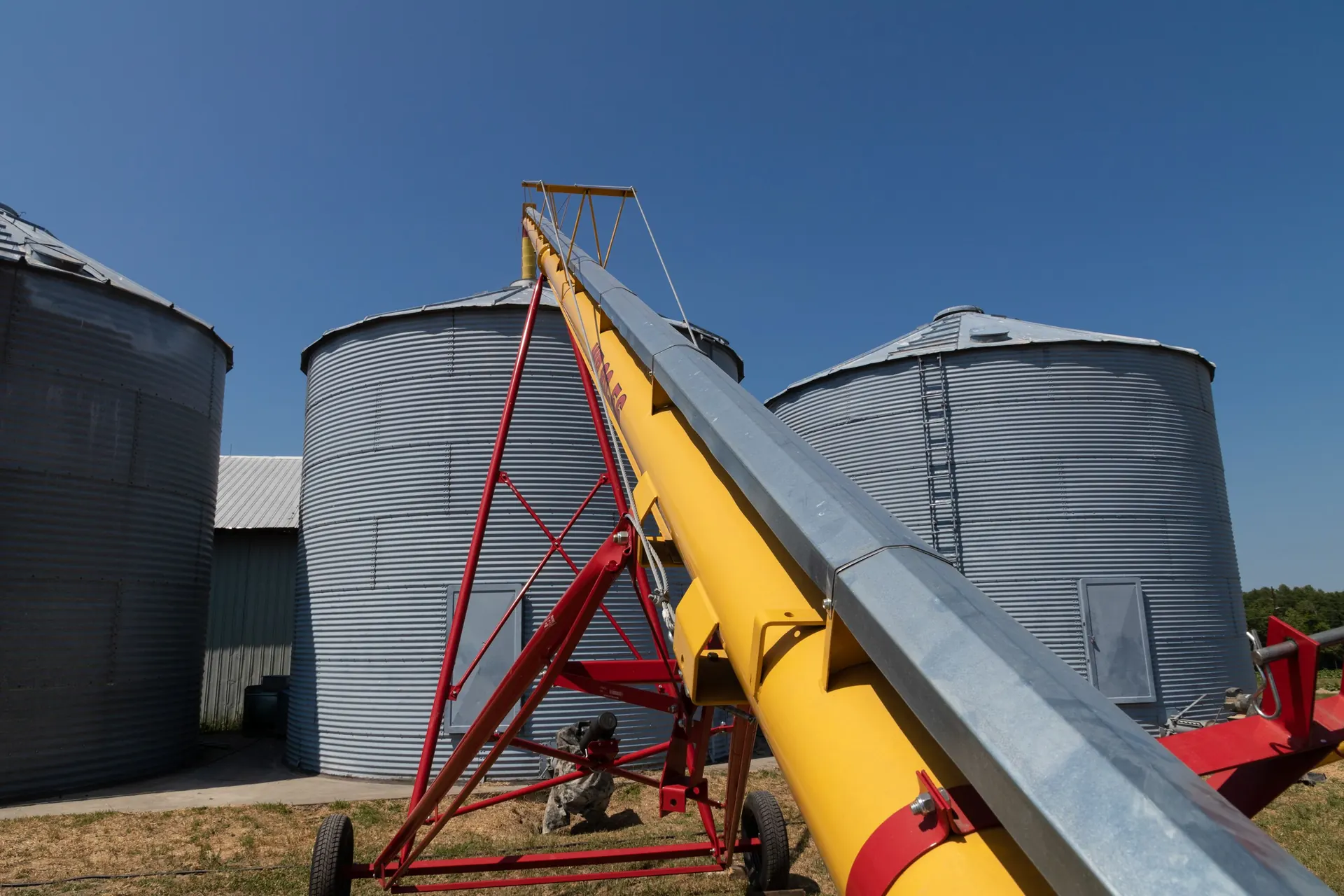
Corrugated, bolted steel construction creates thousands of linear millimeters of horizontal ledge per ring where grain dust and insect eggs accumulate. Bolt heads, caulking lines, and vertical seam overlaps are prime harborage. Cleaning must include brush-scrubbing along the corrugation profile — a flat wall wash is not sufficient. Any damaged caulk or gasket must be replaced during cleaning, because failed seals defeat the fumigation sealing you will need later.
Concrete Silos
Concrete walls are smooth but porous and prone to hairline cracking from thermal cycling and settlement. Mold and insect larvae penetrate cracks that a broom cannot reach. Concrete silos generally require crack repair with food-grade sealant, and their large thermal mass means condensation zones form in predictable bands that should be inspected at every cleaning. Fumigation sealing in concrete silos is typically more difficult than in steel.
Safety Before Sweeping: Confined Space Entry, Grain Engulfment, and OSHA Compliance Essentials
No cleaning objective justifies an uncontrolled entry. In the United States, grain storage structures fall under OSHA 29 CFR 1910.272 (Grain Handling Facilities) and, when entry is required, 29 CFR 1910.146 (Permit-Required Confined Spaces). The core controls are non-negotiable.
Entry Controls
- Never enter from below. Entry must be made from the top through a properly rigged manhole or roof hatch. Entering through a side or bottom opening places the entrant beneath the grain mass.
- Lockout/tagout everything. Sweep augers, discharge conveyors, aeration fans, and any unloading equipment must be de-energized and locked before personnel enter.
- Atmospheric monitoring. Test for oxygen (acceptable range 19.5–23.5%), combustible gas (below 10% LEL), carbon monoxide, and hydrogen sulfide before entry and continuously during occupancy.
- Full-body harness with lifeline. The entrant wears a Class III harness attached to a mechanical winch or tripod-rated lifeline, with a second person stationed outside as attendant and a rescue plan rehearsed in advance.
- Never walk down a grain surface. Bridged grain and vertical grain faces can collapse instantly and engulf an adult in seconds.
For a large share of routine cleaning work, the safest engineering control is to eliminate entry altogether. Remote-controlled and robotic cleaning systems exist precisely because the hazard cannot be fully mitigated by procedure alone.

Pre-Clean Inspection Checklist: Identifying Bridging, Ratholing, Caked Material, and Structural Red Flags
Inspection comes before cleaning, and it should be documented with photographs and a written condition report. The inspection serves two purposes: it tells you what cleaning method to use, and it identifies structural problems that cleaning crews must not disturb.
Flow and Material Problems
- Bridging: A crust or arch of grain spanning the silo cross-section. Often signaled by a hollow sound when tapped, or by grain discharging intermittently in surges.
- Ratholing: A vertical channel formed through the grain mass while surrounding material remains static. Visible as a funnel-shaped depression on the surface.
- Caked material: Hard, adhered grain masses on walls and in corners, usually the result of moisture migration and repeated wetting cycles.
- Fines accumulation: Fine material concentrated at the center of flat-bottom bins, frequently the ignition source in a dust explosion scenario.
Structural Red Flags
- Outward bowing or localized buckling of wall panels or corrugation rings
- Elongated, sheared, or missing bolts at ring seams and stiffener connections
- Base ring corrosion, foundation cracking, or visible anchor bolt distress
- Roof panel distortion, sagging, or separation at the eave
- Vertical seam caulk failure, perforated wall sections, or blocked aeration slots
Any of these conditions should be escalated to a structural engineer before cleaning proceeds. Aggressive mechanical cleaning near a compromised wall can accelerate a failure.
Combustible Dust and Ignition Control: Preventing Dust Explosions During Silo Cleaning
Grain dust is a recognized combustible dust with a dust deflagration index (Kst) typically in the 60–140 bar·m/s range and a maximum explosion pressure around 7–9 bar for many grain dusts. Minimum ignition energy for dust clouds is frequently in the tens of millijoules — well within the range of a static discharge. Layer ignition temperatures commonly fall between 250°C and 400°C, meaning hot bearings, welding slag, or a failed light fixture can ignite accumulated dust.
Cleaning operations are inherently the highest-risk period because they liberate settled dust into suspension. NFPA 652 (Fundamentals of Combustible Dust), NFPA 61 (Agricultural and Food Processing Facilities), and NFPA 654 (Combustible Particulate Solids) provide the governing framework in North America. The practical controls are:
- Use HEPA-filtered industrial vacuums — never compressed air blowdown, which creates a dust cloud by design.
- Use non-sparking tools: brass or bronze scrapers, plastic scoops, and non-ferrous shovels.
- Bond and ground all conductive equipment, vacuum hoses, and the silo structure itself.
- Use only intrinsically safe or explosion-proof lighting inside the structure.
- Control hot work with a formal permit; a fire watch must remain for at least 30 minutes after welding stops.
- Keep the dust layer on horizontal surfaces below the facility's documented threshold — typically 1/32 inch (0.8 mm) over 5% of floor area, per common housekeeping criteria.
Silo Cleaning Methods Compared: Manual Sweeping, Pneumatic Whips, Industrial Vacuum, and Robotic Systems
No single method suits every structure. The table below reflects how experienced operators select equipment based on bin type, residue condition, and entry risk.
| Method | Best Application | Entry Required | Relative Speed | Key Limitation |
|---|---|---|---|---|
| Manual sweeping and scraping | Final detail work, hopper transitions, small bins | Yes | Low | Highest exposure to engulfment and dust |
| Pneumatic wall whips / air lances | Wall and corrugation cleaning in steel silos | Yes (or remote) | Medium | Generates large dust clouds; requires suppression controls |
| Industrial HEPA vacuum | Dust and fines removal, aeration floor slots, enclosed spaces | Often yes | Medium | Slow on caked or bridged material |
| Remote-controlled / robotic systems | Flat-bottom bins, bridged material, high-risk structures | No | High | Higher capital or contract cost; requires trained operators |
In practice, most thorough cleanings combine methods: robotic or remote removal of the bulk heel, vacuum extraction of fines, then a controlled-entry detail pass for inspection and seam-level work. Manxing's engineering team routinely designs silos with cleaning access, inspection ports, and hopper geometry selected specifically to reduce the residual heel volume that must be cleaned at all.
Tools of the Trade: Equipment, PPE, and Rigging a Professional Silo Cleaning Crew Relies On
Personal Protective Equipment
- Full-body harness with dorsal D-ring, shock-absorbing lanyard, and mechanical retrieval winch
- Supplied-air respirator or powered air-purifying respirator with P100 filtration — dust masks are not adequate for mold, dust, or fumigant residue
- Hard hat with chin strap, safety glasses or sealed goggles, hearing protection
- Chemical-resistant gloves, coveralls, and non-slip safety footwear
- Personal gas detector worn on the chest or shoulder, alarmed for O2, LEL, CO, and H2S
Rigging and Cleaning Equipment
- Tripod or davit arm rated for confined space rescue, with winch and lifeline