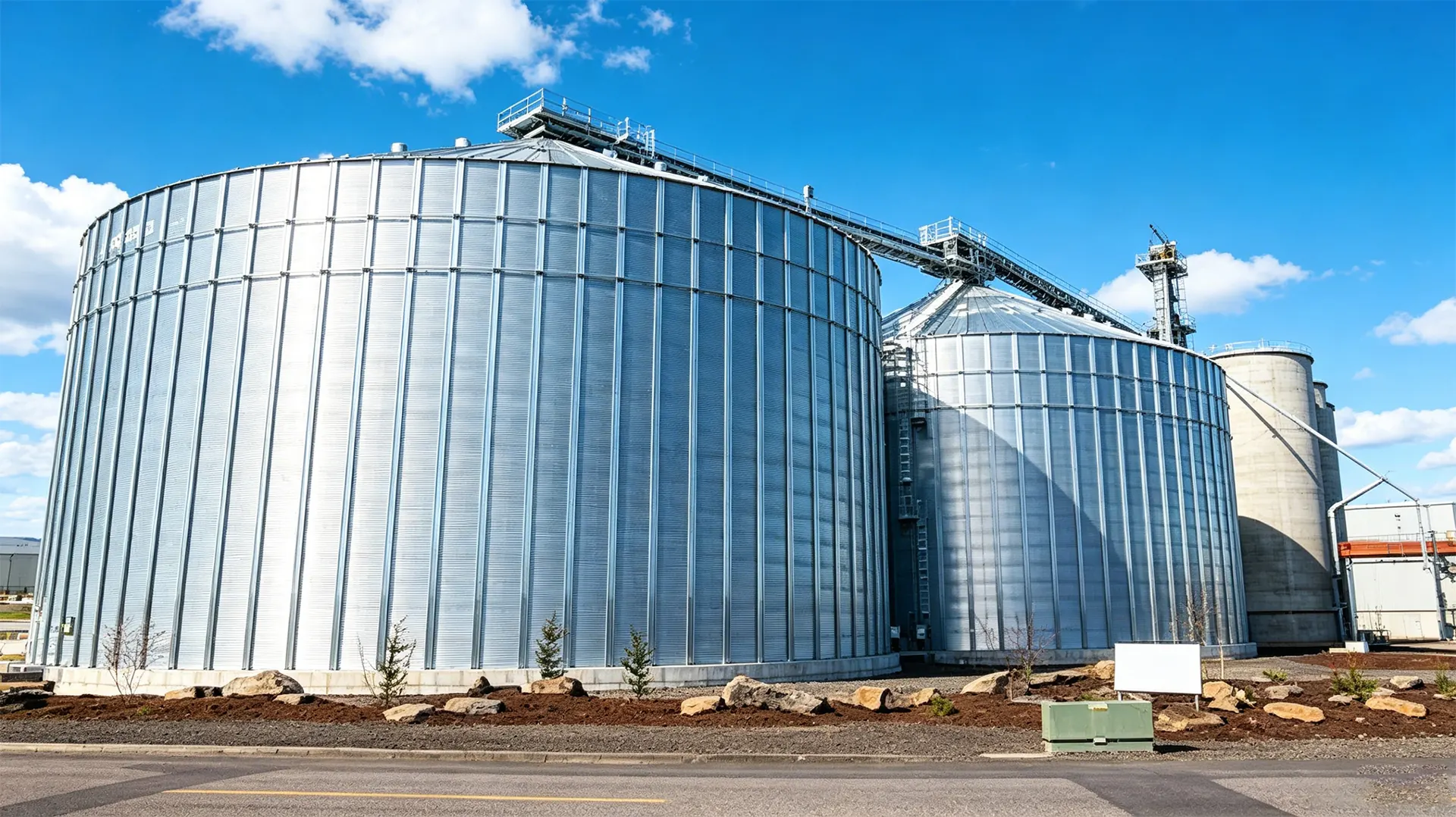
An eccentric discharge outlet is one of the most common — and most underestimated — Conveyor Belt Tracking Issues: Causes and Fixes of premature silo Ventilation Fan Failure: Diagnosis and Repair Guide for G... worldwide. When the draw point sits off the silo's vertical axis, the stored bulk solid no longer loads the wall symmetrically, and the resulting patch pressures, bending moments and dynamic pulsations can exceed concentric design assumptions by a factor of two or more. Understanding eccentric discharge stability is therefore not an academic exercise; it is the difference between a silo that lasts forty years and one that buckles in its third fill cycle.
1. Eccentric Discharge Stability Explained: Why Off-Center Outlets Threaten Silo Integrity
Eccentric discharge occurs whenever the effective flow channel does not coincide with the silo's vertical centreline. In practice this happens for three reasons. The first is deliberate: a single side outlet, a side-silo arrangement, or a discharge point offset to suit an existing Conveyor Belt Tracking Issues: Causes and Fixes or pit layout. The second is geometric: a hopper whose apex is offset from the shell axis, or a multi-outlet arrangement where only one outlet is opened at a time. The third is operational and far more insidious — a silo designed with a perfectly concentric outlet that has been converted, by partial blockage, partial gate opening, or by an insert that has shifted, into an eccentric discharge vessel.
The engineering consequence is that the classical axisymmetric assumption embedded in most silo calculations — the Janssen equation and its derivatives — collapses. Janssen's solution assumes that the vertical stress on any horizontal slice is uniform across the cross-section, which is only valid when the material descends uniformly. In an eccentric discharge, material descends rapidly within a narrow flow channel adjacent to the wall, while the bulk of the inventory remains stationary or creeps downward far more slowly. That velocity difference is the root of every pressure anomaly that follows.

2. Eccentric vs. Concentric Discharge: How Outlet Position Rewrites Flow Patterns and Wall Loads
In a concentric discharge, the flow channel is a vertical cylinder centred on the silo axis. The stored material within the channel moves as mass flow or as a central pipe, and the surrounding material either moves inward symmetrically or remains as a dead zone. Because the geometry is rotationally symmetric, the wall sees a uniform ring of normal pressure plus a uniform frictional traction. The wall is loaded in pure hoop tension with negligible bending, and the design problem reduces to a single hoop stress check at each elevation.
Move the outlet off-centre and the symmetry breaks immediately. The flow channel migrates toward the wall, and three things happen at once:
- Local overpressure on the flow-channel side. The rapidly moving material in the channel mobilises higher wall friction, and the wall adjacent to the channel experiences pressures well above the Janssen prediction.
- Local underpressure on the opposite side. Because the material on the far side is essentially static, it retains much of its fill pressure — but because the silo must remain in global vertical equilibrium, the imbalance is redistributed.
- Circumferential redistribution and bending. The pressure difference around the circumference forces the shell ring to bend as well as stretch, converting a membrane problem into a combined membrane-plus-bending problem.
This is why a silo that analyses perfectly well under concentric assumptions can fail without warning. The hoop tension may still be within allowable limits, but the local bending moment at the edge of the flow channel can push the wall into a buckling regime that no simple hoop check will detect.

3. The Mechanics of Asymmetric Pressure: Patch Loads, Bending Moments, and Hoop Stress Reversal
The patch load mechanism
The accepted engineering model for eccentric discharge loading is the patch load. Rather than trying to model the exact flow channel, the patch load idealises the effect as a localised band of elevated pressure applied over a limited height and a limited arc of the circumference, typically on the side toward which the material flows. Outside that patch, the pressure is taken as the concentric value.
The patch is characterised by two dimensions: its vertical extent (commonly related to the silo diameter, often around one half to one full diameter in height) and its circumferential extent (frequently taken as the width of the flow channel, projected onto the wall). The magnitude of the patch pressure is expressed as a multiple of the local concentric horizontal pressure, with amplification factors typically in the range of 1.5 to 3.0 depending on the code and the assumed flow channel geometry.
Hoop stress reversal
The most damaging feature of patch loading is that it does not simply increase the hoop tension — it can reverse it. On the far side of the silo, the global equilibrium requirement means the ring is pulled inward relative to the near side. In thin-walled steel silos, this produces a local region where the hoop stress passes through zero and into compression. Compressive hoop stress in a thin cylindrical shell is a buckling problem, and the critical buckling stress for an imperfect shell is a small fraction of the yield stress — often 15–25% of yield for a real, fabricated, imperfect shell.
Add the simultaneous vertical compression from wall friction and the self-weight of the shell, and you have a biaxial compressive stress state at exactly the elevation where the patch load is most severe. This is the mechanism behind the great majority of reported eccentric-discharge silo failures.
4. Funnel Flow, Piping, and Ratholing: Flow Channel Formation in Eccentrically Discharging Silos
The flow pattern that develops in an eccentrically discharging silo is almost always funnel flow, regardless of what the hopper angle was designed for. In funnel flow, only a narrow channel above the outlet is mobile; the rest of the contents is stagnant. Three specific channel shapes matter:
Channel geometry types
- Wall-adjacent channel: the channel runs down the inside face of the shell. This is the most damaging case because the moving material drags directly on the wall over its full height, maximising the frictional overpressure.
- Interior pipe: the channel forms inside the bulk, remote from the wall. Wall loads are less severe, but the pipe can collapse suddenly, causing a violent load surge.
- Slanting channel with a stagnant nose: the channel widens upward and leans against one side. This produces the classic asymmetric patch load and is the configuration assumed in most modern design codes.
Ratholing is the extreme outcome: the channel empties, the outlet blocks, and a stable vertical void remains surrounded by material that will not flow without intervention. Operators frequently respond by opening a second outlet or by hammering the wall — both of which can convert a stable rathole into a sudden collapse, releasing a large mass of material and generating an impact load far greater than any design discharge load.

5. Eccentricity Ratio and Outlet Geometry: Quantifying the Threshold Where Stability Fails
Eccentricity is normally quantified as a dimensionless ratio. The most useful definition compares the horizontal offset of the effective flow channel centre to the silo's internal diameter — or, for a hopper, to the hopper outlet diameter. Whichever normalisation is used, the practical thresholds are broadly consistent across research and field experience:
| Eccentricity ratio (e/D or e/dc) | Expected behaviour | Design implication |
|---|---|---|
| < 0.10 | Near-concentric flow; minor asymmetry | Concentric design with a modest overpressure allowance is usually adequate |
| 0.10 – 0.25 | Clear flow channel formation; measurable patch pressure | Patch load check recommended; verify bending capacity at the channel edge |
| 0.25 – 0.50 | Dominant eccentric flow; hoop stress reversal likely | Eccentric discharge must govern the wall design; buckling check mandatory |
| > 0.50 | Severe asymmetry; wall-adjacent channel almost certain | Reconsider the outlet layout; discharge aids and inserts are usually required |
Two geometric details amplify the effect beyond the raw ratio. First, outlet size relative to the silo diameter: a large outlet in a small silo produces a wide channel that engages a large arc of the wall. Second, hopper geometry: a shallow hopper with a flat or near-flat bottom encourages wall-adjacent channels, while a steep mass-flow hopper